Showing posts with label Warren Chappell. Show all posts

Saturday, June 4, 2011

WARREN CHAPPELL: PETER AND THE WOLF FOLLOW UP

MY LAST POST on Warren Chappell's music series, a series which includes three titles by John Updike, was a link to a full scan of Chappell's Peter and the Wolf. A little over a month later, Stephanie of Our Little Library posted in the comments that she had a 1973 paperback edition with extensive differences from the first edition I had scanned. Stephanie has just posted images of the 1973 edition and pointed out all of those differences. Again, it is amazing to see how an artist (or perhaps a publisher in this case?) edits, reimagines, or repurposes art from edition to edition. Thanks, Stephanie.

All images are copyrighted © and owned by their respective holders.

Sunday, March 20, 2011

WARREN CHAPPELL WRAP UP

AS PROMISED IN MY LAST POST, I have now posted illustrations from the four remaining Warren Chappell music books on my Flickr. The true masterpiece is Peter and the Wolf, which I have posted in full. It is unclear whether the text for the book was written by Serge Prokofieff himself, although it seems doubtful. It does sport an introduction by Prokofieff's United States Agent Serge Koussevitzky. If you click into any of the links in this post, click into Peter and the Wolf. It really is superb.

To see all of the full page illustrations and some spot illustrations and adornments for the other titles in the series see: Hansel and Gretel, The Nutcracker, The Sleeping Beauty, and Coppelia. See also, my original post on John Updike's titles in the series. Enjoy.

All images are copyrighted © and owned by their respective holders.

Thursday, March 17, 2011

WARREN CHAPPELL

"A GOOD BIBLIOGRAPHY is needed to give a picture of the several hundred books I have made in the past sixty years, and so a sampling is all that can be attempted in so short a space." This perhaps wry understatement in Warren Chappell's autobiographical essay is followed by a list of no less than sixty-five titles. I have chosen to limit myself even further to the more manageable eight titles that make up the music series: Peter and the Wolf (1940), Hansel and Gretel (1944), The Nutcracker (1958), The Sleeping Beauty (1961), The Magic Flute (text by John Updike, 1962), The Ring (text by John Updike, 1964), Coppelia (1965), and Bottom's Dream (text by John Updike, 1969).


WARREN CHAPPELL was born July 9, 1904 in Richmond, Virginia on his grandfather's truck farm. His grandfather "had been involved with socialism since the 1880s, despite his service from sixteen to twenty throughout the Civil War." His father worked as a manager for a railroad company and his mother as a secretary at a publishing house. Chappell's artistic talent was recognized at a young age to the extent that an elementary art teacher arranged for a "large vat of clay at the [school] I was attending so I could practice modeling after hours like those who had to practice piano and violin." He attended public high school and then the University of Richmond, neither of which offered quite the artistic instruction he hoped for. Consequently, upon reading of the Art Students' League of New York, he made arrangements to spend the summer of 1923 there, and then resolved to attend the League upon graduation from college in 1926. During his time at the Art Students' League he began working in several capacities in the book trade. His steadiest employment was as the promotional art director at the weekly magazine Liberty. In 1931, Chappell moved to Germany to study at the Offenbacher Werkstatt with Rudolf Koch, a master type designer. "With Koch...Instead of learning how to design a letter, I was helped to learn what a letter is." After one year, Chappell returned to the United States and worked as a freelancer in New York City until 1935 when he moved west to Colorado Springs in order to study with Boardman Robinson, an illustrator that had been a seminal inspiration to him when Chappell was a boy.


"We returned to New York in September of 1936...Almost immediately, I was asked to act as designer and adjunct illustrator for a new edition of the 'Junior Classics,' a multivolume collection published by Crowell-Collier who were responsible for 'The Harvard Classics.' Aside from the physical appearance of the set, I was to make illustrations where classic ones were unavailable. The project was under the direction of Anne Carroll Moore, the almost legendary figure in the history of twentieth-century juvenile literature. It is likely that Henry Quinan recommended me for the commission."

"I have been fortunate in knowing a number of the key players in the field of children's books: Frances Clarke Sayers of the New York Public Library and Bertha Mahoney Miller of The Horn Book, for instance, but it was Lillian Bragdon, at Knopf, who managed to make me feel most comfortable with her commissions, and that is what an editor is supposed to do. Our first notable collaboration was Peter and the Wolf, by Prokofieff. We included the musical themes and made the book in a long, narrow format. Serge Koussevitsky was Prokofieff's representative in America and it was he who brought the work to the attention of his friends, Blanche and Alfred Knopf. The publication date was 1940."

 At this point, Chappell's career becomes impossible to encapsulate. He did pivotal work for every major house and many minor publishers and served for thirty-four years as consultant to the Book-of-the-Month-Club. He produced editions of Shakespeare, Don Quixote, Flaubert, Mark Twain, Melville, Tom Jones, Jane Austen, Charles Dickens, Robert Frost, All the King's Men, and countless others.


"Eighteen years had elapsed since Peter and the Wolf and fourteen since Hansel and Gretel, when I returned to what was to become the music series with The Nutcracker. [For more art from The Nutcracker see my post from this past Christmas.] The suggestion came from Virginie Fowler, editor of Knopf juveniles. I felt it was necessary to prepare a text that would return to the spirit of the Hoffman original and kept that in mind while make the adaptation. In the intervening years, I had developed the use of retoucher's warm opaques in making my speparations which could give me greater control of the value combinations. The text was set in monotype Bembo and this continued for the succeeding five titles in the series."


For Chappell's thoughts on the three books in the music series with text by Updike see my previous post here.


In 1970, at the request of The New York Times, Chappell wrote a book about printing entitled A Short History of the Printed Word. A second edition was released in 1999. In 1978, Chappell became artist-in-residence at the University of Virginia where he had already begun to deposit his archives. He remained in the position until his death of heart failure on March 26, 1991.


The quotes for this post come from Warren Chappell's autobiographical essay in volume ten of Gale's journal Something About the Author (1990). Additional background information from "Warren Chappell." Contemporary Authors Online, Detroit: Gale, 2003. I hope to post more images from all of these books (including at least one book in full) shortly.


All images are copyrighted © and owned by their respective holders.

Tuesday, March 1, 2011

JOHN UPDIKE: BOTTOM'S DREAM

AS PROMISED YESTERDAY, I have posted Bottom's Dream adapted from William Shakespeare's A Midsummer Night's Dream by John Updike with music by Felix Mendelssohn and illustrations by Warren Chappell in its entirety on my Flickr. To fully understand Warren Chappell's book design, it's important to see the way the music is integrated into the text, the black and white spot drawings that work as marginal illuminations, the typesetting, the use of color, and the full page color drawings. On every page is a mix of many disparate graphic elements all brought together in a carefully measured way. Enjoy.

Coming Soon: Warren Chappell

All images are copyrighted © and owned by their respective holders.

Monday, February 28, 2011

JOHN UPDIKE: WARREN CHAPPELL'S MUSIC SERIES

OUTSIDE OF HIS MAGAZINE WORK, it is hard to imagine John Updike as a hired writer. But his entry into children's literature was just that, as a hired writer. Through the 1960s, Updike wrote three adaptations for Warren Chappell's music series: The Magic Flute (1962), The Ring (1964), and Bottom's Dream (1969). All of the books follow the same form as Chappell's other books  in the series, which can be gleaned from the highly accurate credits. For example, Bottom's Dream adapted from William Shakespeare's A Midsummer Night's Dream by John Updike with music by Felix Mendelssohn and illustrations by Warren Chappell. In short, a synopsis of the source music's story with selections of staff music and Chappell illustrations throughout.


So who just decides to "hire" John Updike to write the text for a children's book? To give you a sense of who Warren Chappell was, I quote from his autobiography:
"I had thought of The Magic Flute for a very long time but wondered about a writer who could tell the story in the mere three thousand words which were mandated by the format. The one person who seemed right was John Updike, and I inquired to find his editor at Knopf. It turned out to be Alfred himself who served as contact."
In case you missed that, it was Alfred Knopf himself that made the introduction. At this point, Updike had published a book of poetry, a book of short stories, and only two novels. He was a rising star--that second novel was Rabbit, Run--but was still a relatively young and new talent. It was Chappell, illustrator, designer, author, typeface designer, who was the great master.

He continues:
"John agreed to the Mozart and then suggested The Ring. Finally, we did Bottom's Dream, the dream sequence from A Midsummer Night's Dream. It was a very satisfying collaboration, and that promise made by Bottom, the weaver, that he would get Peter Quince to write up his experience and it would be called Bottom's Dream, had finally come to pass."
Chappell is best known now as a typeface designer and as the author of A Short History of the Printed Word (1970), but his work in books is so long and varied that it is hard to condense while still giving it the necessary weight. He worked on well over four hundred books published over fifty years including editions of Winnie the Pooh, Moby Dick, and Don Quixote, not to mention any additional works set in the types he designed, Lydian series, Trajanus series, and Koch Uncial (co-designed with Paul Koch). I will skim the surface of that career and talk more about the music series in a future post.


As for Updike's texts in the series, they serve their purpose. The prose is unmistakably Updike, but all of the weaknesses of the original stories are carried into the books, which makes for thin and confusing children's books.

The best of the books is undoubtedly The Ring. Even people without any knowledge of the Wagner opera can follow Updike's telling of the story, which reads like a children's version of Lord of the Rings.


"This is a story of greed and love, of giants, dwarfs, and gods. It happened long ago, in Germany, the land of the mighty river Rhine. Even to this day the river glitters as if with gold--but people say it is just the sun striking the water.

In those old days the gold was real."

In all three of the books, the amount of text and the complexity of the language make these suited for elementary school age children.


I have posted all of Chappell's color illustrations for The Magic Flute and The Ring on my Flickr page. I hope to post Bottom's Dream in full later this week to better show Chappell's overall design, and the way music is integrated into the text. The quotes and background material for this post come from Warren Chappell's autobiography in volume ten of Gale's journal Something About the Author (1990).

Coming Soon: Warren Chappell

All images are copyrighted © and owned by their respective holders.

Wednesday, December 22, 2010

MERRY CHRISTMAS


MERRY CHRISTMAS EVERYONE. In honor of the holiday, I offer a preview of a series I had hoped to post this calendar year that will have to wait for next. All of the biographical material, context, and many more images will come in the new year. Here is the great Warren Chappell's rendition of the perennial holiday classic The Nutcracker.


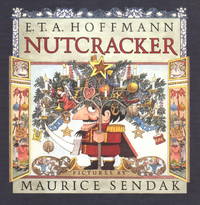
For those of you who have never read the original E. T. A. Hoffmann story, may I recommend the legendary translator Ralph Manheim's translation illustrated by the legendary children's book luminary Maurice Sendak.


And as a holiday bonus, I refer you back to my Christmas in June post, Ilonka Karasz's The Twelve Days of Christmas and the Karasz illustrated Phyllis McGinley's Merry Christmas, Happy New Year.


Happy New Year. Enjoy it in good health.

All images are copyrighted © and owned by their respective holders.