IT IS ALWAYS EXCITING when a well-deserving book comes back into print, and while I will always remain fond of the original illustrations, it's hard not to take special notice when the illustrator is Mary "I-illustrated-this-little-series-called-Harry-Potter" GrandPré. The book is Chinua Achebe's How the Leopard Got His Claws, which I wrote about quite extensively in May 2010 during my Chinua Achebe series. The new edition comes out in September and has a surprisingly extensive preview available on Amazon. Thanks to Susan Kusel over at Wizards Wireless for the tip.
All images are copyrighted © and owned by their respective holders.
Being a Compendium of Children’s Books by Twentieth
Century “Adult” Authors Currently Out of Print
Showing posts with label Chinua Achebe. Show all posts
Saturday, July 30, 2011
Friday, May 7, 2010
CHINUA ACHEBE WRAP UP AND NEW RICHARD ERDOES
ONE LAST THING TO SHARE with regards to Chinua Achebe's children's books. This article in the Daily Independent from this past January entitled "In Search for Viable Content for Children." The article outlines the history of Nigerian children's literature and postulates on its future. Two of Chinua Achebe's books are mentioned as exemplars of the form.
AND I HAVE POSTED another Richard Erdoes (a.k.a. the illustrator of James Joyce's The Cat And the Devil) book on my Flickr set: What's Inside? (1968) by Barbara Shook Hazen. The cover appears below.
Thursday, May 6, 2010
CHINUA ACHEBE: THE FLUTE
THE FLUTE is one of two picture books published by Chinua Achebe in 1977 (for information on the other, see The Drum). Like The Drum, The Flute is an adaptation of a traditional Igbo folktale.
A man takes his family of two wives--the senior wife with many children and the other wife with just one--to work on their distant farm at the border of the human and the spirit lands. They are careful to return home before nightfall when the spirits come out to tend their own crop of yams. Upon returning home, however, the only son of the younger wife finds that he has forgotten his flute in the fields. It is a flute he made with his own hands, and he is determined to retrieve it despite his parents' pleas to stay home.
When he reaches the farm, the spirits are indeed out. Their leader speaks: "'Taa! Human boy! Who sent you here? What are you looking for? Foolish fly that follows the corpse into the ground, did nobody tell you that we are abroad at this time?'"
The boy explains he has returned for his flute that he made with his own hands. The spirit asks if he would know this flute when he saw it, and the boy answers yes. The spirit leader then produces a golden flute, which the boy rejects, a shining flute, which the boy rejects, and finally the boy's beaten bamboo flute, which he claims.
The spirit leader demands a song.
The spirits are pleased and offer the boy one of two pots. The boy chooses the smaller pot, which proves to provide food and riches for his family.
But the senior wife is jealous of these rewards. She takes her eldest son and his flute to the farm, and contrives for the flute to be left. She sends her son to retrieve it from the spirits. On meeting the spirits, this son chooses the golden flute when it is offered. Then, when the spirits give him the choice of jars he chooses the large jar. He brings the pot to his mother, who securely locks them in their hut before opening the jar.
"Immediately leprosy, smallpox, yaws and worse diseases without names and every evil and abomination filled the hut and killed the woman and all her children." The next morning, on hearing no noise from the hut, the father races to open the door. He only just manages to close it before any of the unnamed evils enter the world.
THE FLUTE WAS ILLUSTRATED by Tayo Adenaike, one of the seven artists that make up the Nsukka Group, a collective of Nigerian artists based out of the University of Nigeria, Nsukka.
The Nsuka Group are characterized by their inclusion of uli design in their artwork, a traditional art form practiced by Igbo women as body designs for special occasions. Despite uli's history, the Nsuku Group is made primarily of men. They use European techniques and materials joined with uli to craft a Nigerian art style that incorporates Igbo culture.
To see all of Tayo Adenaike's illustrations for The Flute, see my Flickr set here. For other books by Chinua Achebe, see Chike and the River, How the Leopard Got His Claws, and The Drum.
Information on Tayo Adenaike came from the website of The National Museum of African Art's exhibit The Poetics of Line, and the website Heavensgate.
All images are copyrighted © and owned by their respective holders.
Wednesday, May 5, 2010
CHINUA ACHEBE: THE DRUM
STARTING WITH HIS FIRST NOVEL, THINGS FALL APART, Chinua Achebe incorporated traditional oral folktales into his writing. It was instrumental in how he shaped a distinctly African voice in modern African literature written in English. In that book, the longest spoken story is "Tortoise and the Birds," in which the tortoise tricks the birds into allowing him to come with them to a feast in the sky where he then, through wordplay, manages to claim the entire feast for himself. The tortoise, in Igbo and other African traditions, is a trickster animal, a deceitful character who breaks traditional norms either for his own gains or simply for the fun of it. Consistent with his belief that an African writer's responsibility is to rekindle an appreciation of African culture, Achebe turned to the tortoise again in one of two adaptations of Igbo folktales for children that he published in 1977, The Drum.
"Long, long ago, when the world was young, all the animals lived together in one country. In those days there were not as many tortoises as there are today but only one tortoise, Mbe, the ancestor of all tortoises..."
In this idyllic world, a time of famine comes. Tortoise, in desperation, journeys out in search of food. At last he comes upon a palm tree with "thrice four hundred" ripe palm fruits. Atop this palm tree, one of the fruits slips from Tortoise's hand. Unwilling to give up even one of these succulent fruits, Tortoise descends. But the fruit has fallen into a hole, and Tortoise follows.
Tortoise has found his way into the Spirit World, where a spirit child has just eaten his fruit. Tortoise demands recompense and in payment, and the spirits give Tortoise a drum. Upon returning home, Tortoise finds that the drum can provide an endless supply of food.
After a week of feasting, at last certain that the food will not run out, Tortoise decides to share his riches under the condition that the animals make him king. So starved are the animals that they agree. Tortoise, who has decided that beating a drum is beneath a king's dignity, assigns elephant to beat the drum at his coronation ceremony. But the elephant beats the drum too hard.
The drum is broken. And with no drum, no king. "'What's the good of a king without a food drum?'"
So Tortoise returns to the Spirit World. He tricks the same spirit child into eating another of his palm fruits, and then parlays that insult into another drum. But this time, the spirits allow him to choose his drum from many. Tortoise chooses the largest drum, of course.
Upon his ascent, Tortoise tests the drum, and "masked spirits with bundles of whips appeared from nowhere and began rushing and jumping around and hitting at everything in their way." They are followed by wasps and bees. Tortoise is badly beaten and stung; it takes days to recover.
When Tortoise regains consciousness, he chooses to share his new "gift" as he did his old. He makes a big show out of holding back the drum until the time is right, but his "subjects" chant, "We! Want! It! Now!! The! King! Of! Drums!!" Tortoise, after locking himself safely in his hut, complies. "As for the animals, what they saw that evening has never been fully told. Suffice it to say that they dragged themselves out of Tortoise's compound howling and bleeding."
IN "ACHEBE ON EDITING," an interview that first appeared in World Literature Written in English, Achebe says that The Drum is a story from tradition that "I decided to make a political story...by making the tortoise want to use the power that he has over the other animals to attempt to become their king." In this way, Achebe makes Tortoise a prototypical post-colonial leader who may initially have good intentions, but in the end is corrupted by power, and brings only terror to his people. Achebe goes on:
To see all of Anne Nwokoye's illustrations for The Drum, see my Flickr set here. For other books by Chinua Achebe, see Chike and the River and How the Leopard Got His Claws.
Tomorrow: Chinua Achebe's The Flute
Background on Achebe's composition of The Drum, including quotes from "Achebe on Editing," came from Chinua Achebe: A Biography by Ezenwa-Ohaeto and The Chinua Achebe Encyclopedia by M. Keith Booker.
All images are copyrighted © and owned by their respective holders.
"Long, long ago, when the world was young, all the animals lived together in one country. In those days there were not as many tortoises as there are today but only one tortoise, Mbe, the ancestor of all tortoises..."
In this idyllic world, a time of famine comes. Tortoise, in desperation, journeys out in search of food. At last he comes upon a palm tree with "thrice four hundred" ripe palm fruits. Atop this palm tree, one of the fruits slips from Tortoise's hand. Unwilling to give up even one of these succulent fruits, Tortoise descends. But the fruit has fallen into a hole, and Tortoise follows.
Tortoise has found his way into the Spirit World, where a spirit child has just eaten his fruit. Tortoise demands recompense and in payment, and the spirits give Tortoise a drum. Upon returning home, Tortoise finds that the drum can provide an endless supply of food.
After a week of feasting, at last certain that the food will not run out, Tortoise decides to share his riches under the condition that the animals make him king. So starved are the animals that they agree. Tortoise, who has decided that beating a drum is beneath a king's dignity, assigns elephant to beat the drum at his coronation ceremony. But the elephant beats the drum too hard.
The drum is broken. And with no drum, no king. "'What's the good of a king without a food drum?'"
So Tortoise returns to the Spirit World. He tricks the same spirit child into eating another of his palm fruits, and then parlays that insult into another drum. But this time, the spirits allow him to choose his drum from many. Tortoise chooses the largest drum, of course.
Upon his ascent, Tortoise tests the drum, and "masked spirits with bundles of whips appeared from nowhere and began rushing and jumping around and hitting at everything in their way." They are followed by wasps and bees. Tortoise is badly beaten and stung; it takes days to recover.
When Tortoise regains consciousness, he chooses to share his new "gift" as he did his old. He makes a big show out of holding back the drum until the time is right, but his "subjects" chant, "We! Want! It! Now!! The! King! Of! Drums!!" Tortoise, after locking himself safely in his hut, complies. "As for the animals, what they saw that evening has never been fully told. Suffice it to say that they dragged themselves out of Tortoise's compound howling and bleeding."
IN "ACHEBE ON EDITING," an interview that first appeared in World Literature Written in English, Achebe says that The Drum is a story from tradition that "I decided to make a political story...by making the tortoise want to use the power that he has over the other animals to attempt to become their king." In this way, Achebe makes Tortoise a prototypical post-colonial leader who may initially have good intentions, but in the end is corrupted by power, and brings only terror to his people. Achebe goes on:
I don't think I have altered the meaning and flavour of the story. In my own estimation what I have done is to make it applicable to our situation today. And I believe that this is what the makers of these traditions intended to do - to tell stories that would be applicable to that day...
To see all of Anne Nwokoye's illustrations for The Drum, see my Flickr set here. For other books by Chinua Achebe, see Chike and the River and How the Leopard Got His Claws.
Tomorrow: Chinua Achebe's The Flute
Background on Achebe's composition of The Drum, including quotes from "Achebe on Editing," came from Chinua Achebe: A Biography by Ezenwa-Ohaeto and The Chinua Achebe Encyclopedia by M. Keith Booker.
All images are copyrighted © and owned by their respective holders.
Tuesday, May 4, 2010
CHINUA ACHEBE: HOW THE LEOPARD GOT HIS CLAWS
HOW THE LEOPARD GOT HIS CLAWS (1972) started as a manuscript written by John Iroaganachi in 1967 called How the Dog was Domesticated. When it was published five years later under its final title, the book was credited to Chinua Achebe first, Iroaganachi second. But its authorship is even more complicated.
The complete credits read: How the Leopard Got His Claws by Chinua Achebe and John Iroaganachi with The Lament of the Deer by Christopher Okigbo, illustrated by Per Christiansen. Those are a lot of names for one thirty-five page children's picture book. To understand why, you need to have a basic understanding of modern Nigerian history, most specifically an understanding of the Nigerian Civil War, also known as the Nigerian-Biafran War.
But before a very rudimentary and poorly informed history lesson, the book.
The animals live in edenic peace with the leopard as king. Only the dog has sharp teeth and the other animals mock him for it. One day, the deer approaches King Leopard about constructing a common shelter from the rain. All the other animals embrace the plan...except for the dog who keeps out of the rain in his cave (and the duck, who doesn't mind getting wet).
The rest of the animals work hard, each contributing to the construction, and at last complete their work. At the celebratory feast to celebrate the opening of the hall, King Leopard says, "'This hall is yours to enjoy. You worked very hard together to build it. I am proud of you.'"
But then the rains come, and the dog is forced from his cave to seek shelter in the animals' hall. When the deer challenges the dog's right to use the shelter, the dog attacks.
The deer calls for help.
The leopard, who was away at another village, returns, but without teeth or claws, he is quickly vanquished. His subjects refuse to rally behind him, but rather capitulate to the dog and name him their king.
The leopard, injured and alone, leaves. He makes his way to a blacksmith, and says, "'I want the strongest teeth you can make from iron. And I want the most deadly claws you can make from bronze.'" He then goes to thunder, and says, "'I want some of your sound in my voice....Even a little bit.'" Upon hearing his story, both consent, and he returns home armed and ready.
Back home at the shelter, the leopard devastates the dog and subdues his former subjects through fear. They try to claim that he has always been their king, but he announces that the former peace they knew is no more, and from then on he will rule through fear.
The dog runs to the human hunter and offers to be his slave in return for sanctuary from the leopard.
Today the animals are no longer friends, but enemies. The strong among them attack and kill the weak. The leopard, full of anger, eats up anyone he can lay his hands on. The hunter, led by the dog, goes to the forest from time to time and shoots any animals he can find. Perhaps the animals will make peace among themselves some day and live together again. Then they can keep away the hunter who is their common enemy.IN EARLY 1967, Chinua Achebe and Christopher Okigbo, the poet and friend who had solicited Chike and the River from Achebe for Cambridge University Press, started Citadel Press to, according to Ezenwa-Ohaeto in Chinua Achebe: A Biography, "publish relevant works by Africans for children, thereby encouraging the exploration of the oral traditions of the people." One of the first manuscripts they received was How the Dog was Domesticated by John Iroaganachi. In that version the dog was a good fellow who was enslaved. Achebe, however, was seized by the manuscript, and promptly rewrote it, turning it into the quite different story above.
In July of 1967, the Biafra region in south eastern Nigeria seceded, declaring itself the Republic of Biafra. When Nigeria sent troops to reclaim Biafra, a civil war began that would last for two and half years. Achebe and Okigbo resided in Biafra. Okigbo joined the army to support Biafra and in September 1967, he was killed. His death ended the newborn Citadel Press.
In January 1970, the war ended with Biafra once again part of Nigeria.
In post-war Nigeria, there was much discontent and Achebe often found himself in opposition to the government. Friends, Arthur Nwankwo and Samuel Ifejika, started Nwamife Books in order to publicize the horrors of the civil war. Achebe was included in their first publication, an anthology The Insider: Stories of War and Peace from Nigeria. It was through this association with Nwamife Books that How the Leopard got his Claws at last saw print.
Okigbo, who had become something of a martyr, had written the Lament of the Deer for the book before his death, and while short and less than inspiring, its inclusion was of great importance. And during the war, the Scandinavian countries had been sympathetic to Biafra, which was how the Norweigian illustrator Per Christiansen was brought on as illustrator, making what seems a simple animal fable into an international book grown out of war.
Tomorrow: Chinua Achebe's The Drum
Background on Achebe's composition of How the Leopard Got His Claws came from Chinua Achebe: A Biography by Ezenwa-Ohaeto and The Chinua Achebe Encyclopedia by M. Keith Booker.
All images are copyrighted © and owned by their respective holders.
Monday, May 3, 2010
CHINUA ACHEBE: CHIKE AND THE RIVER
WHEN HIS DAUGHTER STARTED PRESCHOOL IN NIGERIA IN 1965, Chinua Achebe was alarmed to find how much racism was built into the books she was exposed to at school. Even when the teachers, who were predominantly white, presented the material with no personal bias, the stories themselves contained racial stereotypes that portrayed Africans as primitive and superstitious. Achebe was, at that time, the recognized voice of modern African literature ever since the publication of his novel Things Fall Apart (1958). As editor of the African Writers Series and director of external broadcasting at the Nigerian Broadcast Service where he founded the Voice of Nigeria, he was a major cultural leader. It was in this capacity that his good friend and former classmate, the poet Christopher Okigbo, then serving as the manager of the Cambridge Press for West Africa, approached him about writing a children's book.
Achebe had given a lecture in Leeds the year before entitled "The Novelist as Teacher." He said his role as a novelist was "to help my society regain belief in itself and put away the complexes of the years of denigration and self-abasement." With this purpose in mind, Achebe saw himself as a teacher as well as a novelist. And while he had intended his "teachings" for people of all ages, his work had so far been addressed to adults. His experience as a parent, however, showed him that he could not ignore Nigeria's children. So as a novelist and as a concerned father, he wrote Chike and the River (1966).
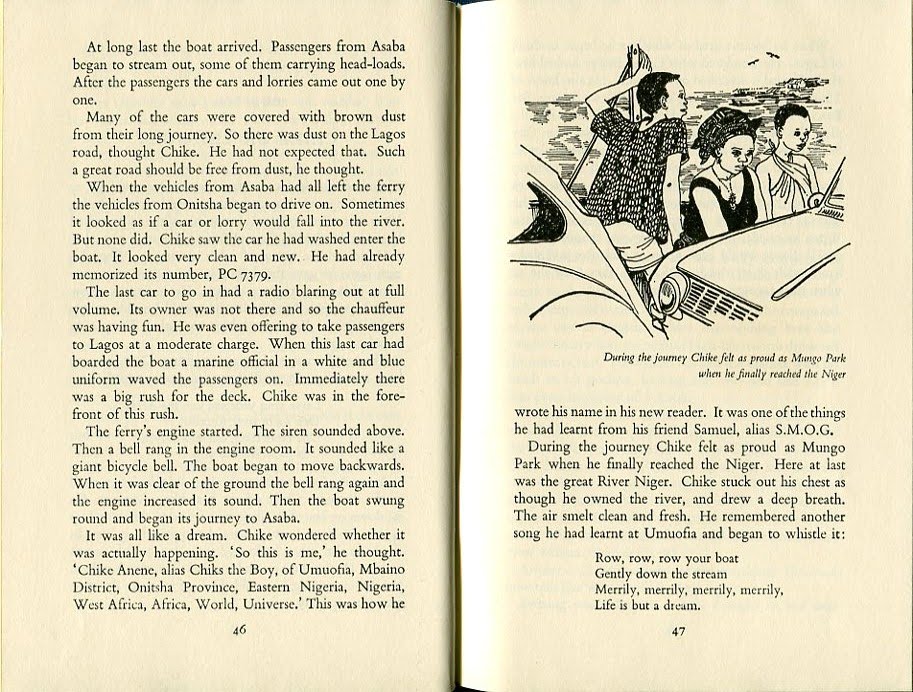
Chike and the River is a sixty-page chapter book intended for middle readers with illustrations by Prue Theobalds. Chike, a Nigerian boy, moves from his native village of Umuofia to the city of Onitsha to live with his uncle.
In the city, Chike is overwhelmed by how different life is from what he had known in Umuofia. "In Umuofia every thief was known, but here [in Onitsha] even people who lived under the same roof were strangers to one another." His uncle is stern, and the friends he makes at school are mischievous, often leading Chike astray.
From his first day at school, the children talk about one thing: Asaba, the city on the opposite bank of the Niger River. It can be reached by ferry, "sixpence to go over and sixpence to return." But Chike has no money.
After many ill-conceived plans for acquiring the necessary ferry fee, Chike stumbles on the idea to wash the cars of people waiting to cross the river. "When he had finished [washing the car] he told the owner [who] ... brought out a handful of coins and gave one to Chike. ... Chike's dream had come true; at last he could go to Asaba."
Once in Asaba, Chike is disappointed by how unimpressive the town is. But when he decides he has seen enough, he finds that he has missed the last ferry back to Onitsha. With no place to stay, Chike takes refuge in the back of a lorry.
The lorry turns out to belong to a gang of thieves. Chike overhears the thieves make arrangements with a night watchman and then load their lorry with stolen goods. Chike avoids discovery, and in the morning when he awakes, "He was amazed by what he saw. A man tied to a mango tree."
It is the night watchmen, who begins to tell the police that he had been overpowered by thieves. But Chike steps up, "'I saw the thieves...This man helped them.'" Chike's testimony leads to the arrest and conviction of the thieves, and Chike becomes a hero.
Chike and the River suffers from strong didacticism and that workshop woe "telling" instead of "showing." Achebe acknowledged that he found writing for children difficult, and the difficulty feels like the awkward discomfort some adults get around children. The book's final paragraph shows this well:
Tomorrow: How the Leopard Got His Claws.
Background on Achebe's composition of Chike and the River came from Chinua Achebe: A Biography by Ezenwa-Ohaeto and The Chinua Achebe Encyclopedia by M. Keith Booker.
Achebe had given a lecture in Leeds the year before entitled "The Novelist as Teacher." He said his role as a novelist was "to help my society regain belief in itself and put away the complexes of the years of denigration and self-abasement." With this purpose in mind, Achebe saw himself as a teacher as well as a novelist. And while he had intended his "teachings" for people of all ages, his work had so far been addressed to adults. His experience as a parent, however, showed him that he could not ignore Nigeria's children. So as a novelist and as a concerned father, he wrote Chike and the River (1966).
Chike and the River is a sixty-page chapter book intended for middle readers with illustrations by Prue Theobalds. Chike, a Nigerian boy, moves from his native village of Umuofia to the city of Onitsha to live with his uncle.
In the city, Chike is overwhelmed by how different life is from what he had known in Umuofia. "In Umuofia every thief was known, but here [in Onitsha] even people who lived under the same roof were strangers to one another." His uncle is stern, and the friends he makes at school are mischievous, often leading Chike astray.
From his first day at school, the children talk about one thing: Asaba, the city on the opposite bank of the Niger River. It can be reached by ferry, "sixpence to go over and sixpence to return." But Chike has no money.
After many ill-conceived plans for acquiring the necessary ferry fee, Chike stumbles on the idea to wash the cars of people waiting to cross the river. "When he had finished [washing the car] he told the owner [who] ... brought out a handful of coins and gave one to Chike. ... Chike's dream had come true; at last he could go to Asaba."
Once in Asaba, Chike is disappointed by how unimpressive the town is. But when he decides he has seen enough, he finds that he has missed the last ferry back to Onitsha. With no place to stay, Chike takes refuge in the back of a lorry.
The lorry turns out to belong to a gang of thieves. Chike overhears the thieves make arrangements with a night watchman and then load their lorry with stolen goods. Chike avoids discovery, and in the morning when he awakes, "He was amazed by what he saw. A man tied to a mango tree."
It is the night watchmen, who begins to tell the police that he had been overpowered by thieves. But Chike steps up, "'I saw the thieves...This man helped them.'" Chike's testimony leads to the arrest and conviction of the thieves, and Chike becomes a hero.
Chike and the River suffers from strong didacticism and that workshop woe "telling" instead of "showing." Achebe acknowledged that he found writing for children difficult, and the difficulty feels like the awkward discomfort some adults get around children. The book's final paragraph shows this well:
So Chike's adventure on the River Niger brought him close to danger and then rewarded him with good fortune. It also exposed Mr Peter Nwaba, the rich but miserly trader. For it was he who had led the other thieves.Such a pat ending and overt tying off of loose ends comes across as either lazy or exasperated, a desire to just be done with it. Achebe discovered what will be something of a theme on We Too Were Children, Mr. Barrie: an ability to write for adults does not necessarily translate into an ability write for children. With his next three children's books, Achebe chose a mode more suited to his audience and his purposes--picture books about talking animals.
Tomorrow: How the Leopard Got His Claws.
Background on Achebe's composition of Chike and the River came from Chinua Achebe: A Biography by Ezenwa-Ohaeto and The Chinua Achebe Encyclopedia by M. Keith Booker.
Subscribe to:
Posts (Atom)