"EVERYBODY has read some of
Grimm's Tales," writes Randall Jarrell in his introduction to
The Rabbit Catcher and Other Fairy Tales of Ludwig Bechstein, "but it is surprising how few people have read German fairy tales translated from other books." Jarrell sets out to remedy that with his second contribution to Macmillan's series of marvelous tales, three stories by Ludwig Bechstein.
Bechstein was a contemporary and ardent admirer of the Grimms. When they refused to allow him to produce an abridgment of their work, he chose to write his own book of fairy tales, which was published in 1845. Jarrell: "In his introduction to his book Bechstein calls the fairy tale 'the restless and homeless, floating bird-of-pardise of innocent tradition.'" Bechstein managed to catch that 'bird-of-paradise.' His volume outsold the Grimms' in Germany until the 1890s.

From the introduction through the translations, Jarrell's Bechstein is far more relaxed than
his Grimm. Where the Grimm introduction quoted at length from a German poet and mentioned the H-bomb, the Bechstein introduction includes revealing intimacies: "I never heard anyone called a heavenly man before, but it's already become a family phrase in my family." Throughout the whole book, the reader can sense how much fun Jarrell is having.
The tales are "The Rabbit Catcher," "The Brave Flute-Player," and "The Man and the Wife in the Vinegar Jug." Jarrell says, "The stories, even down to their last bit of style, are as plain and homely as can be." But he means this as a compliment. His love for the stories is apparent. Except he takes especial care to make clear that the "Fisherman and His Wife" variant "The Man and the Wife in the Vinegar Jug," holds nothing to the original.

"THE RABBIT CATCHER" is of the variety of tales where a young suitor is set a series of impossible tasks in order to earn the right to wed the princess. When given the first task--to lead one hundred rabbits out to the fields, let them graze for the day, and bring every single one back--he asks for a day to think it over. As he is fretting over this challenge, a little, old lady gives him a whistle and tells him, "'Take good care of it, it will do a lot for you!'" With the whistle in hand, he agrees to the challenge.
But the king and princess are concerned that the boy might succeed. Each comes to him in the field in disguise asking to buy a rabbit, so that he will not have all one hundred when he returns. First he convinces the princess to kiss him in exchange for a rabbit, and then the king to kiss his donkey. But as each leaves, he uses the magic whistle to recall the bunnies, and at the end of the day he brings all one hundred in.

The whistle helps with the next task--to separate one hundred bushels of peas and a hundred bushels of lentils in the dark--by bringing a swarm of ants who complete the challenge, and the last--to eat a roomful's worth of bread in a night--by bringing "so many mice..that it was almost sinister."
Having completed the challenges, the king tries one last trick to try to cheat the boy out of the princess's hand: he must fill a bag of lies. But when the boy starts to say that he had made the king kiss a donkey, the king cuts him off, says the bag is full, and relinquishes his daughter.
"THE BRAVE FLUTE-PLAYER" tells of a musician who stops for the night at a farm, where he learns that the nearby abandoned castle is home to a treasure that no one can claim, because it is haunted and everyone who has gone in at night has never returned. Unafraid, the musician goes into the castle, and the farmer, left at home, can gauge how the musician is faring, because the sound of his flute drifts down to the farm.

At eleven o'clock, two men carry in a coffin and leave. The musician opens the coffin--the farmer is sure he is dead, because the music has stopped--takes out the little shriveled corpse, sets it by the fire, and soon it comes to life. The wrinkled, little man leads the musician to a room full of gold, and tells him if he can evenly divide the gold in two, half would belong to him and half would go to the poor. The musician divides the piles of coins, but there is one left over. He cuts it in half, making him the first to succeed in one hundred years, and the old man grants him the money. The musician begins to play, and the farmer is overjoyed at the sound.
"THE MAN AND THE WIFE IN THE VINEGAR JUG," as Jarrell said in his introduction, is a variant of "The Fisherman and His Wife." In this, it is a golden bird who grants each of the couple's escalating wishes, and for no apparent reason. And unlike the fisherman who is driven to each new wish by his greedy wife, here both members of the couple seem equally eager to first live in a cottage, then in the city, then as nobles, as king and queen, and at last as God. With that request, "
Bang, all their magnificence went down to the devil, and both of them, the man and his wife, were back in the vinegar jug again."
 THE RABBIT CATCHER
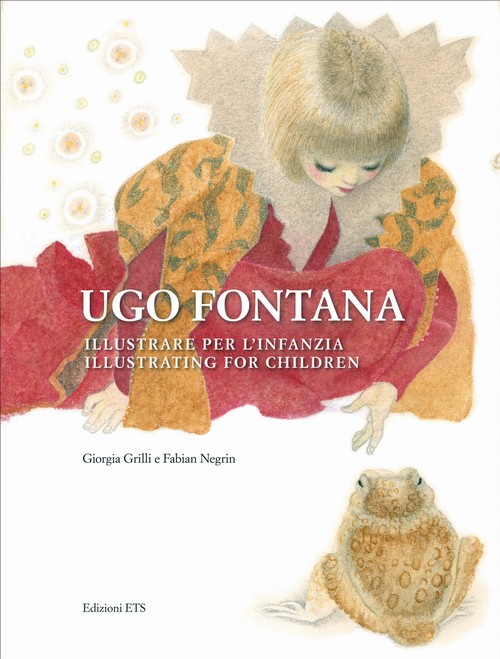
'S BEAUTIFUL ILLUSTRATIONS were done by Ugo Fontana, a legend of children's book illustration in his native Italy. Fontana was selected this year as the first illustrator to be spotlighted in the annual exhibition 'The Lost Treasure' at the Bologna International Children's Book Fair. A
200-page bilingual book was released in conjunction with the festival. If anyone has this book and is trusting enough to lend it to me, I will happily devote a blog post to this amazing illustrator. To see all of his illustrations for
The Rabbit Catcher, view
my Flickr set here.
For information on Ludwig Bechstein, I consulted
The Teller's Tale: Lives of the Classic Fairy Tale Writers edited by Sophie Raynard.
NEXT: Jarrell's Original Children's Books
All images are copyrighted © and owned by their respective holders.

 Eventually, Andersen is able to convince his passionate fan to return to bed, promising to "go and play with children in other countries," but he asks one last parting question, "which of my tales [do] you like best?"


