Showing posts with label Nancy Ekholm Burkert. Show all posts

Tuesday, June 3, 2014

RANDALL JARRELL'S GRIMM: THE ILLUSTRATORS


WHEN NANCY EKHOLM BURKERT'S picture book Snow-White and the Seven Dwarfs was published in 1972, John Gardner writing in The New York Times said, "People who care about book illustrations have known for some time that one of the best illustrators to be found is Nancy Ekholm Burkert...[and] her new book...transcends her previous accomplishments." He then goes on to say, "Looking at [the illustrations], you wish they were the first pictures you'd seen in your life...Though...I would not wish that the first fairy tale I ever heard was a version by Jarrell. I find his version anything but faithful."

Gardner's harsh criticism, however, must be a minority opinion if the caliber of illustrators who have chosen Jarrell's text is any indication. In addition to Burkert, the legendary Maurice Sendak and the Caldecott-winning illustrator Margot Zemach have also taken turns illustrating the stories that originally appeared in Jarrell's The Golden Bird and Other Fairy Tales. The Brothers Grimms' tales are a children's book illustrator's delight, a chance to showcase her art the way that an actor puts his stamp on Shakespeare. And artists of Burkert, Sendak, and Zemach's stature can take their pick of translations, or even warrant new translations. But all three chose Jarrell, and through his translations created some of their best work.


LONG TIME READERS OF WTWC,MB, will remember how highly I revere Nancy Ekholm Burkert. Snow-White has become her legacy, appallingly the only one of her books (save her most recent) that remains in print. This is because the American Library Association awarded Burkert the prestigious Caldecott Honor for it, recognizing it as one "of the most distinguished American picture books for children."


The book in its first edition was 12.25" x 9.25" making it a little too big for my scanner. So my scans, as it seems are most of the scans available online, are slightly cropped. The good news is that you can easily see the illustrations as they are meant to be seen by buying the book now.


MAURICE SENDAK, who needs no introduction, was Jarrell's primary illustrator, illustrating three of Jarrell's four original children's books. In 1962, when Jarrell turned in his Grimm translations, editor Michael di Capua was so happy with them that he thought about commissioning a larger translation from the poet. di Capua approached Maurice Sendak about illustrating the expanded Grimm, but before the project progressed any further, Jarrell turned in his original story The Bat-Poet. di Capua convinced Sendak to illustrate the new book, and plans for a new Grimm were put on hold. When Jarrell died in 1965, the Grimm book had never begun.

Several years later, Sendak and the Austrian-born author Lore Segal started work on their own Grimm. Growing out of the earlier project, four of Jarrell's five translations were included: "The Fisherman and His Wife," "Hansel and Gretel," "The Golden Bird," and "Snow-White and the Seven Dwarfs."

In his preparatory notes for the illustrations for "The Fisherman and His Wife," (the woman pointing at the rising sun above; right: preliminary sketches) Sendak wrote, "No fish! No hut! No palace! Her à la Grafina Potatska! Yes!" Grafina Potatska, an idiotic Polish count, was what Sendak's mother called his father when she was angry with him. The woman's expression is his mother's. The puppy on the bed is Sendak's golden retriever Io.

Sendak found that the more familiar tales were harder to illustrate. The single illustration for "Snow White" took over six months with several iterations. The illustration for "Hansel and Gretel" took two weeks. His goal with each illustration was "catching that moment when the tension between story line and emotions is at its greatest." For "Snow White," he focused on the conflict between the older generation and the young generation. For "Hansel and Gretel" he tried to capture the moment "the very second before she performs her fearless deed."


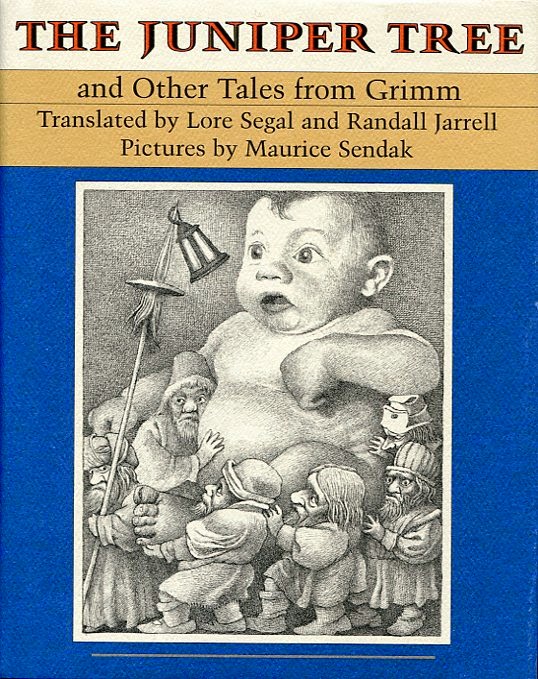
There are twenty-three other stories in Sendak's Grimm, entitled The Juniper Tree and Other Tales from Grimm and still in print. Sendak said of the book, "It was a watershed book for me, one that solved a great many technical and emotional problems...a hard job, which took many years of preparation and concentrated effort."


ON MARGOT ZEMACH'S DEATH, Maurice Sendak said, "Margot not only revivified the American picture book, but was one of the very few who helped elevate it to an art form." Awarded the Caldecott Medal in 1974 for her book Duffy and the Devil, she also received two Caldecott Honors in the 1970s. In 1980, Zemach published her rendition of Jarrell's telling of The Fisherman and His Wife. On its appearance, Kirkus Review said, "'If The Fisherman and His Wife' must be illustrated, let it be by Margot Zemach--who has the comic-cataclysmic range, the vigor, the intelligence for the task."


Kirkus comments on Jarrell's translation as well, quoting his "well-chosen words....His is a less patterned telling than, say Wanda Gag's--richer in language, fuller in incident."

All of Zemach's illustrations for the book are brilliant, overflowing with energy and details that make the story her own. Unfortunately out of print, I have posted many more illustrations on my Flickr set here.

IN UPCOMING POSTS, I will further explore Sendak and Jarrell's collaborations as well as work by some of the other artists who have worked on Jarrell's children's books. For background information on Maurice Sendak's work in this post, I consulted The Art of Maurice Sendak by Selma G. Lanes.

All images are copyrighted © and owned by their respective holders.

Thursday, February 17, 2011

NANCY EKHOLM BURKERT

MOST BIOS OF NANCY EKHOLM BURKERT, illustrator of John Updike's A Child's Calendar, sum up her career as follows: she is the original illustrator of Roald Dahl's James and the Giant Peach, which was her first published illustration work for children, and she received a Caldecott Honor in 1973 for Snow-White and the Seven Dwarfs. This is not a shabby biography. But there must be more to the career of the illustrator chosen as the second artist ever to be given an exhibition at the Eric Carle Museum of Picture Book Art after none other than Maurice Sendak.

NANCY EKHOLM BURKERT was born February 16, 1933 in Sterling, Colorado. By the time she was twelve she had lived in five states, settling in Wisconsin in 1945. "Because I felt very alone as a child," she wrote in 2007, "drawing became my companion, and my bridge to the World." She wrote and illustrated her first picture book (unpublished) in high school while also serving as editor of the year book and taking art courses at the Wustum Museum. "As a child...my picture books provided my only source of visual art," but as she grew her influences became much broader. She majored in art at the University of Wisconsin in Madison, and completed a masters on a George S. Kaufman fellowship for female graduate students. During that time she studied the old masters and came to admire the Flemish masters of the 15th and 16th centuries in particular. It was her discovery of Eastern art that was most revelatory, however. "I discovered my affinity with Asian art, especially early Chinese painting. My preference is for linearity, which can express for me grace, rhythm and harmony...the Spirit I feel in everything."

Above: From Hans Christian Andersen's The Nightingale

When she speaks of linearity, she means actual line work, a focus on meticulous detail developed line by line. Click on the below image to examine the corduroy hat in this portrait of her daughter.


Burkert received the commission for her first illustrated children's book, James and the Giant Peach, after a picture book she had written and illustrated was accepted at Knopf. The book was in rhyme and detailed the story of an "aerial lady" and "what happens when kites break their strings and disappear; sort of a great lost-and-found in the sky." Like the book written in high school, the story of the aerial lady never saw publication.


To achieve the level of detail Burkert demands, the artist does exhaustive research both in the field "on location" and in books and museums. She often spends as much time on research as creating the pictures. Snow-White took her three years to complete, and her labor of love Valentine & Orson required seven years.


Above: Images from Meindert De Jong's The Big Goose and the Little White Duck, researched in the Wisconsin countryside.

Such rigorous and time consuming practices has resulted in a relatively small output of only ten books and a scattering of magazine illustrations.

Above: Endpapers from Edward Lear's The Scroobious Pip completed by Ogden Nash

In addition to her work as an illustrator, Burkert has curated museum exhibitions such as Drawing: The Fundamental Art at the Milwaukee Art Museum in 1981 and an exhibition on representations of peace in children's books, which showed in New York as well as Milwaukee. In the 1990s, she founded a program called Bread and Books that brought books to needy children and their families in Milwaukee soup kitchens.

  
Above: From Acts of Light, selected poems of Emily Dickinson

Amazingly, all of Burkert's books save Snow-White and the Seven Dwarfs are out of print. I have posted additional samples of her work on my Flickr account. Follow the links to see more art from Meindert De Jong's The Big Goose and the Little White Duck and from the selected poems of Emily Dickinson Acts of Light. And in case you missed it, all of the art from Updike's A Child's Calendar. I hope that Ms. Burkert would consider this renewed exposure a belated birthday gift; she turned seventy-seven yesterday.

My primary sources for Nancy Ekholm Burkert's biography were Michael Danoff's introduction to the 1977 monograph The Art of Nancy Ekholm Burkert and Burkert's own "letter" in the book Artist to Artist: 23 Major Illustrators Talk to Children About Their Art. I also consulted the Wisconsin Library Association's Notable Wisconsin Authors website, an honor Burkert received in 1995.


All images are copyrighted © and owned by their respective holders.

Wednesday, February 9, 2011

JOHN UPDIKE: A CHILD'S CALENDAR

JOHN UPDIKE was one of the most decorated American authors of the second half of the twentieth century. He won two National Book Awards, two Pulitzer Prizes, three National Book Critic Circle Awards, two O. Henry awards, the PEN/Faulkner, the PEN/Malamud, the William Dean Howells Medal, and others. He published, depending on how you count, seventy books in his lifetime, comprised of novels, short stories, poetry, criticism, drama, and non-fiction. But most important to We Too Were Children, Mr. Barrie, he also published five children's books. The first of those books to be wholly of original material (the others are adaptations and will be discussed in a future post) is A Child's Calendar (1965).

A CHILD'S CALENDAR is a collection of twelve simple poems, one for each month. They attempt to be distillations of those months, ostensibly from a child's point of view. However, they seem more concerned with the sun, sky, and earth than most children probably are ("hot dogs, fries, / And Coke" yes; "The blushing, girlish / World unfolds" less so). As James Dickey wrote in his New York Times review "there is too much sense of clever over-simplification about [Updike's] verse; one is aware of the adult straining for the child's approval, and I should think that the child would also sense it."


Dickey did note that "A Child's Calendar is an attractive little book," which is something of an understatement, illustrated as it was in 1965 by Nancy Ekholm Burkert, Caldecott honor recipient and original illustrator of James and the Giant Peach. And Burkert was only the first Caldecott artist to illustrate the book, which was reissued in 1999 with illustrations by Trina Schart Hyman whose edition was itself a Caldecott Honor book.

What is perhaps the most interesting aspect of this book as an Updike text arises out of the existence of the two editions. It is hinted at in a note in fine print on the copyright page of the Hyman edition: "The text for this new edition incorporates a number of changes by the author." Those changes, for the most part, deal with updating the text for modern readers, eliminating references to burst milk bottles in January (replaced by parkas) or ashes spread on icy streets in February (replaced by salt). While these "corrections" have some nostalgic interest, an ah-how-the-world-has-changed, they also reveal something about how Updike specifically sees the world as having changed. A change of "ice-cream cones" to "hot dogs, fries," or "The playground calls," to "Little League" seems unnecessary (not counting edits made to retain a rhyme, of course) as the originals would still hold interest for children today. Those changes suggest, perhaps, new observations of grandchildren instead of observations of his own children. But the most important change appears in "April."

The original in 1965 reads:
Each flower, leaf
And blade of sod--
Small letters sent
To her from God.
In 1999:
Each flower, leaf,
And blade of turf--
Small love-notes sent
From air to earth.
Why the elimination of God? Especially when the next two lines in both versions are "The sky's a herd / of prancing sheep," which in the original reads like an allusion to God as shepherd and His faithful as a flock, but in the second is just a hackneyed metaphor for clouds. And even more odd is the choice in the final verse to retain the cultural aspect of religion, "At church, they bring / The lilies in," after having so deliberately removing the Deity in the first part of the poem. All of this is further complicated by the poem for November, which contains in both editions the lines "Tall God / Must see our souls." Why eliminate God in the first instance, while not casting Him out of the book as a whole? Unfortunately, the simple children's text does not offer a solution.


THE MOST DISTINCTIVE ASPECT OF BOTH EDITIONS OF A CHILD'S CALENDAR is the illustrations. Nancy Ekholm Burkert and Trina Schart Hyman are simply two of the best children's book illustrators, and both of their interpretations of Updike's text have much to recommend them. Hyman took her cue from Burkert with both editions featuring a spot illustration on the page with the poem and a full page illustration on the facing page. Beyond that, Hyman truly put her own stamp on the material, but not without inserting other quiet homages to Burkert. The upper image above is Burkert's spot illustration for "December." The lower is Hyman's spot illustration for the half title.

Below: Nancy Ekholm Burkert, April (l.), Trina Schart Hyman, March (r.)


Below: Nancy Ekholm Burkert, February (l.), Trina Schart Hyman, November (r.)


Below: Nancy Ekholm Burkert, July (l.), Trina Schart Hyman, July (r.)


HYMAN'S EDITION is still in print, and I encourage everyone to track down a copy. I have posted all of Burkert's illustrations on my Flickr set here, but for those of you who don't also have access to the Burkert text, I've included an appendix below of all of the textual changes between the editions (hopefully that will format properly in whatever reader you're using). Updike, while writing copiously on everything, has done frustratingly little writing on children's literature (as near as I can tell). If anyone knows of anything that he's written that might be relevant, please let me know.

Coming Soon: Nancy Ekholm Burkert


APPENDIX
January: Milk bottles burst / outside the door.
                And parkas pile up / Near the door.
February: And ashes fly / From the old town truck.
                 Though road salt flies / From the old town truck.
April: Each flower, leaf / And blade of sod-- / Small letters sent / To her from God.
           Each flower, leaf, / And blade of turf-- / Small love-notes sent / From air to earth.
June: The playground calls, / The ice-cream man, / And, after supper, / Kick-the-Can.
          There's Little League, / Hopscotch, the creek, / And, after supper, / Hide-and-seek.
July: America: / It makes us think / Of ice-cream cones, / And Coke to drink.
         America: / It makes us think / Of hot dogs, fries, / And Coke to drink.
September: Burning brush, / New books, erasers, / Chalks, and such.
                    Drying grass, / New books and blackboard / Chalk in class.
                   (Also "And" to "While" in third stanza)
November: In its distress
                    Nevertheless
December: Downtown, the stores
                   The toy-packed shops

All images are copyrighted © and owned by their respective holders.