 THE ARTIST FOR LANGSTON HUGHES AND ARNA BONTEMP'S children's novel Popo and Fifina was the Jackie Robinson of commercial art and cartooning, E. Simms Campbell (1906-1971). Campbell had already had a successful career in advertising in Saint Louis, Missouri before moving to New York City, and he was only twenty-five when he did the illustrations for the Hughes/Bontemps book. By then, he'd broken into the New York magazine cover and cartoon markets, and was just two years away from his biggest break, as the cover artist and later art editor of the newly founded Esquire magazine, where his watercolors of beautiful women set the tone of the magazine from the beginning. Later, he brought those women to newspapers all over the country as the first African-American with a nationally syndicated comic, Cuties his daily one panel gag cartoon.
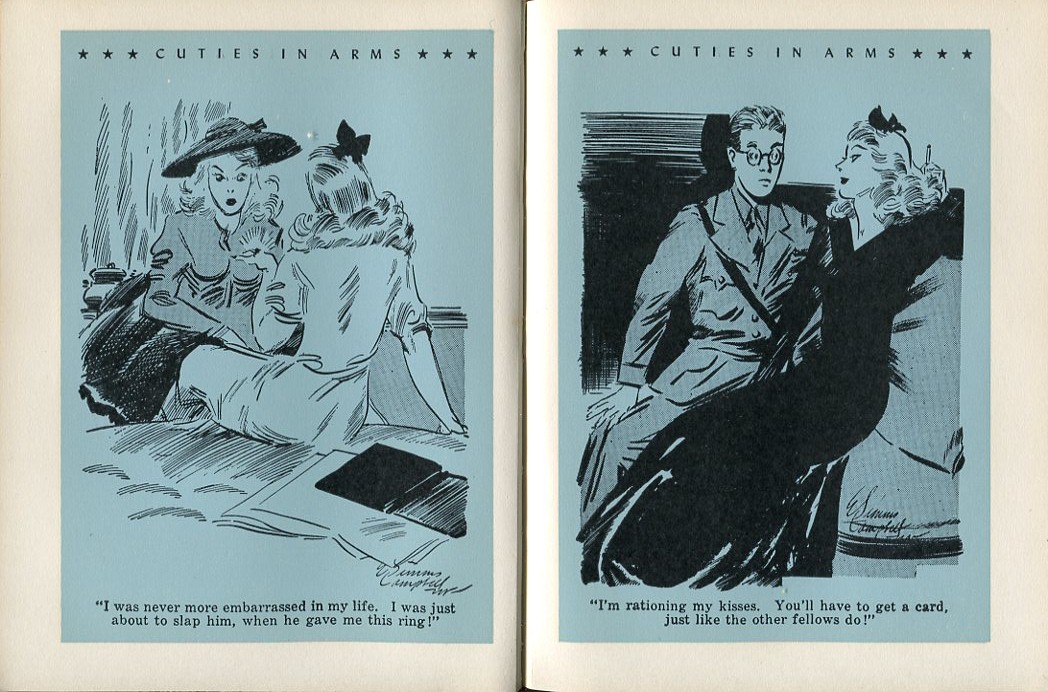
 As such a prominent cartoonist, information on Campbell abounds on the internet. A good capsule biography is available on Answers.com, and a wide selection of his work, including the Impressions of Haiti I posted yesterday, can be found on the American Art Archives. So, in hope of presenting something new here I offer direct quotes from a profile done by none other than Arna Bontemps in 1945. The art comes from a collection of Campbell's cartoons Cuties in Arms (1942), from The New Yorker (where he appeared regularly throughout the thirties), and from Southern Road, a book of poems by Sterling A. Brown published in 1932 and illustrated in the same manner as Popo and Fifina.
IT WAS AT HIS WESTCHESTER HOME IN NEW YORK, fourteen years after their collaboration on Popo and Fifina, that Arna Bontemps sat down with Campbell to do a profile of the black artist for the book We Have Tomorrow. The book profiles twelve African-Americans who, as Bontemps says in the introduction "are doing what was never done by Negro Americans before; they are working in fields which for a long time seemed closed to members of their race. They are doing what couldn't be done--until they did it. They are working as Americans, not as Negroes, and they are making a success of it." The title We Have Tomorrow comes, appropriately, from a Langston Hughes poem, Youth.

"My work is a lot like ditch-digging. The only difference is that when you're digging ditches, you're outside and enjoy the fresh air. I do my sweating right over there [in his home studio]--often at night, under those intense blue lights. Ten hours, twenty hours, sometimes thirty hours at a stretch...When it's time for bills to be paid, you don't play around. You get funny and you get funny quick."
"This month the going has been harder than usual. King Features, for whom I do the syndicated daily drawings called "Cuties," usually want me to keep six weeks ahead with my material, but that's the old plan now. With the war going on, they are asking for seventeen weeks in advance. That means I must work up enough ideas for the additional weeks, get them approved, do the drawings, and then keep even from then on. All that in addition to my regular work for the magazines and the advertising concerns."
"Don't let it get you dizzy. Just say I do about five hundred drawings of all kinds a year--not counting the ones that go into the wastebasket."

On his diverse book collection: "An artist must know something about everything. Styles, furniture, culture, language, mass psychology, and all things of current interest."

On the question of high versus low art: "I prefer cartooning. You see, I like jokes, and it's hard to put a joke into an oil painting. Have you ever noticed how quiet people are in art galleries? Well, I don't think that's what pictures should do to you. They should make you want to laugh, talk, shout, anything but hang your head. I worked at the sort of thing you have in mind, back in the Chicago and St. Louis days, and exhibited such drawings as "The Wake" and "Levee Luncheon," both of which got their share of attention, but even then the thing about them that critics mentioned was their humor."

On finding his calling: "I seem to have had my eye on the magazines from the start. At Englewood [High School} it was The 'E.' At the university of Chicago, the Phoenix. The several other little magazine around Chicago. Nothing much came of these efforts, however, so after the Art Institute I went back to St. Louis to look for work. The next thing I knew I was wating table on a dining car. It was a let-down, of course, but it was the making of me in this field."

"Yes, seriously. Up to then my work had been shallow, but I learned from my fellow waiters how close man can be to his fellow men. After this discovery my character began to develop and I began to paint and draw people as they really looked. Oh, i could always draw, but I was a failute as an artist till I became a successful dining-car waiter."
"You meet all kinds in a diner, you know. Some are dainty, some finicky, some calm and patient, some nervous, some are just would-be slave drivers. Between meals I spent my time making caricatures of the passengers as well as of the other waiters and the steward. Before long I had quite a collection of these sketches, and when I got back in St. Louis I started showing them around to the various studios."

"Most of the places turned me down. You know how it is when you are looking for work. But J. P. Sauerwein, manager of the Triad Studios in the Arcade Building, liked the stuff and hired me. I became one of eight artists on the staff there."

On moving to New York City: "I had plenty of chances to regret it during those first months in the big city. I didn't catch on right away, by any means. I wore out a lot of shoe leather before I found a job. Even then it was nothing to get excited about. The salary was just one-eight of what I'd been getting in St. Louis. But it was a job and I had to hold it until i could do better. In the meantime Mr. Sauwerwein sent me a wire offering an increase over my former pay if I'd come back to the Triad Studios, but it was too late. I'd burned my bridges and I didn't want to be licked by a little place called New York City."

"My break came when I ran into Ed Graham. there aren't many fellows like Ed. He and I had worked on the Phoenix at the same time back at the University of Chicago. Well, Ed Graham had come on to New York ahead of me, and he had already broken into the humorous magazines and made a name for himself. He had his knocks, but he was over the hump. He knew the editors, and they knew him. I should him some of myd rawings and gags and right off the bat he said, 'I'll take you around. This is stuff is good.'"
 "There you have it. C. D. Russell, creater of "Pete the Tramp," became my friend, too. Before long I was selling cartoons to a dozen magazines and newspapers. I sold ideas to other artists, and I sold gags alone, sometimes as many as fifty a week. I enrolled at the Art Student's League for further study with George Grosz, the exiled German satirist, perhaps the greatest drafstman in the field, and received a pat on the back from James Mongomery Flagg. In 1936 the Hearst newspapers conducted their $1000 competition for what was called the cartoon best depicting "the tax grabber." The contest was open to all American artists, so I decided to give it a try. I made nearly a thousand sketches before I got one that pleasd me. Finally, on friday the thirteenth, I finished one that seemed to express what I had in mind. It was just one of ten thousand entries, but it turned out to be the lucky one."
"The principle on which I work is to find out what the other fellow needs, then try to supply it. Something like that was in my mind when I drew that Thanksgiving turkey for Beltach's Butcher Shop [his first sale as an artist made at age eleven], and it is worth remembering. This field isn't hard from a race standpoint, but it is a very, very tough field for anybody to break into and stay in."
THE OTHER ELEVEN PEOPLE Arna Bontemps profiled in We Have Tomorrow are Mildred E. Blount, Horace R. Cayton, Beatrice Johnson Trammell, Dean Dixon, Sylvestre C. Watkins, Douglas Watson, Emmett M. May, Hazel Scott, Algernon P. Henry, James E. LuValle, Benjamin Davis, Jr.
I include one last cartoon from the New Yorker by way of comparison to the print I posted yesterday of Popo at the drum ceremony.

And because I can't bear not to include them, the last two prints from Southern Road.


Coming Soon: Langston Hughes's First Book of Negroes.
All images are copyrighted © and owned by their respective holders.


