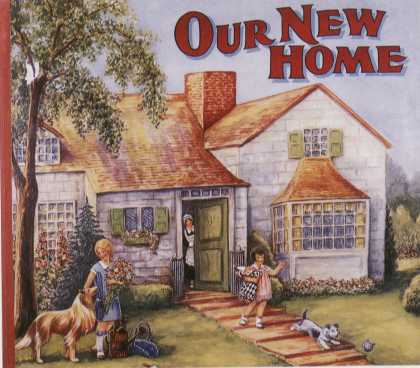
 This weekend is the great unveiling. With absolutely no regard for how far along we would be in setting up our house, we brashly scheduled our housewarming (and daughter's second birthday party) for August 1. And so, here we are, with unopened boxes strewn about, furniture out of place, rooms half painted, bathrooms to clean, snacks to prepare, and seventy people coming in thirty-six hours. Which is to say, We Too Were Children, Mr. Barrie is not going anywhere. But while I am (still going somewhere), We Too Were Children, Mr. Barrie won't be (going somewhere new). I have nevertheless many dozens of images scanned and books read and research begun that will someday culminate in brand new posts right here. But the alarming blare of overdue email notices forced me to return all of the books I had out of the library and my trusty old scanner Blinkin and his mate Dusty the External Hard Drive are still in boxes and and and excuses excuses excuses, there's naive hope that life will settle into a schedule and work can be done and I can share my meager findings to you loyal friends and followers. For now, I'm playing (which is to say working really really hard at) house. Bear with me.
Saturday, July 31, 2010
ARE WE THERE YET?
This weekend is the great unveiling. With absolutely no regard for how far along we would be in setting up our house, we brashly scheduled our housewarming (and daughter's second birthday party) for August 1. And so, here we are, with unopened boxes strewn about, furniture out of place, rooms half painted, bathrooms to clean, snacks to prepare, and seventy people coming in thirty-six hours. Which is to say, We Too Were Children, Mr. Barrie is not going anywhere. But while I am (still going somewhere), We Too Were Children, Mr. Barrie won't be (going somewhere new). I have nevertheless many dozens of images scanned and books read and research begun that will someday culminate in brand new posts right here. But the alarming blare of overdue email notices forced me to return all of the books I had out of the library and my trusty old scanner Blinkin and his mate Dusty the External Hard Drive are still in boxes and and and excuses excuses excuses, there's naive hope that life will settle into a schedule and work can be done and I can share my meager findings to you loyal friends and followers. For now, I'm playing (which is to say working really really hard at) house. Bear with me.

Wednesday, July 7, 2010
PETER MATTHIESSEN: SEAL POOL
IN THE AUTHOR BIO for his only children's novel Seal Pool (1972), Peter Matthiessen thought it important to mention where he went to school (Yale and the Sorbonne), his "much acclaimed novel" At Play In The Fields Of The Lord, and that he used to be a commercial fishermen. He neglected to mention that he was one of the founders of The Paris Review or that he secretly worked for the CIA at the time. (See my earlier entry on George Plimpton whose book was also illustrated by William Pène du Bois.) Were he to update his bio now, Matthiessen might mention that he has twice won the National Book Award: in 1980 for general nonfiction paperback The Snow Leopard, and in 2008 for fiction Shadow Country. But he would probably still humbly obscure his groundbreaking work for environmental conservation and his commitment to expose the tragedies that post-industrial civilizations inflict on pre-industrial peoples, relegating those endeavors to "several other novels, and a number of books on wildlife."
In Seal Pool, Matthiessen's environmental conscience is in the forefront in a story about a Great Auk, a bird thought to have been extinct since 1844, who has taken up residence in New York's Central Park Zoo.

THE STORY STARTS with a framing narrative about Lucas and his sister Sara who is celebrating her fourth birthday with a visit to the Central Park Zoo in New York City. The seals are lazing about instead of giving the proper swimming display Lucas had hoped to show his sister as a birthday present. In fact, all of the animals seem to be asleep or in hiding. As a result, the crowd is thinning. Lucas and Sara are about to leave too when they meet Dr. Frederick Fluke.
The Great Auk was a flightless sea bird that lived in Northern Oceans and has been extinct since 1844. However, the previous month he was at the docks and saw a parcel of crates marked "Bronx Zoo," one of which was labeled "Red-Eyed Hoozis." But it wasn't a Hoozis, it was "A real honest-to-goodness Great Auk, lying on his back with his flippers behind his head!"
In his excitement, the good doctor sits on the Snowy Owl's crate, who then exposes him to all of the animal as "a spy in our midst!"

What follows is a long humorous debate between the animals (the Auk, the Owl, a Polar Bear, a Ptarmigan, an Arctic Hare, an Ivory Gull, a Blue Fox, and a Lemming) and Dr. Fluke, which reads like the Mad Tea Party in Alice's Adventures in Wonderland. Dr. Fluke decides he must save the Great Auk.

The conversation devolves into mere bickering as each animal threatens to eat the other, a perhaps more honest interaction than most discussions between people. Eventually a truck driver from the Bronx Zoo arrives for the delivery. Dr. Fluke talks his way onto the truck. When the truck stops at a traffic light, Dr. Fluke escapes with the Great Auk. They are chased through Central Park, first by the driver, then police, and worst of all an old woman with a surprising amount of ornithological knowledge ("'That's a Great Auk.'").

Dr. Fluke talks his way out of this last encounter by threatening to report the old woman as a crazy person, because someone who thinks she sees extinct animals must be crazy. He finds his way into the Central Park Zoo and just as what has become a crowd of pursuers is upon him, he slips the Auk into the seal pool. There, the other zoo animals enable him to eat unobserved by driving off the crowds of zoogoers by being terribly boring.
The story ends just as a squirrel informs Dr. Fluke that the seals will swim now, fulfilling Lucas's wish to show his sister the seals on her birthday.
FOR A BOOK WITH such an obvious message (prevent animal extinction) it manages to never preach. This might be because the dialogue moves so quickly and it's all so funny. ("'If it weren't for all this eating, Lemmus trimucronatus [lemmings] would rule the earth!'") There are Shakespearean allusions ("'alas, poor Curlew,' sobbed the Ptarmigan. 'I knew him well...'"), playful sarcasm ("'I mean, it never occurred to me that anyone who sees a Great Auk these days must be off their coconut.' He peered at me very queerly with his bright red eye."), and William Pène du Bois's beautiful illustrations throughout. Perhaps the reason that Seal Pool has disappeared (Matthiessen doesn't even include it in his "Also by Peter Matthiessen" list at the beginning of Shadow Country) is because its a little too simplistic for adults, but a little too adult in its humor for children. Or maybe it's just the rather drab title. But then, the British edition didn't seem to help its legacy, and its title has plenty of intrigue.

For all of William Pène du Bois's illustrations for Seal Pool see my Flickr set here.
All images are copyrighted © and owned by their respective holders. The cover of the British edition comes from Page Books list of books by William Pène du Bois.
In Seal Pool, Matthiessen's environmental conscience is in the forefront in a story about a Great Auk, a bird thought to have been extinct since 1844, who has taken up residence in New York's Central Park Zoo.

THE STORY STARTS with a framing narrative about Lucas and his sister Sara who is celebrating her fourth birthday with a visit to the Central Park Zoo in New York City. The seals are lazing about instead of giving the proper swimming display Lucas had hoped to show his sister as a birthday present. In fact, all of the animals seem to be asleep or in hiding. As a result, the crowd is thinning. Lucas and Sara are about to leave too when they meet Dr. Frederick Fluke.
On his right shoulder perched a blue Pigeon and on his left a gray one, and a white Pigeon balanced itself with little flutters on his slouchy hat. So many other Pigeons flew around his head that sometimes it was hard to see his face at all...Dr. Frederick Fluke knows why the animals are on strike. He offers to tell the two children over ice cream sundaes, which they accept. (More innocent times, I guess.) It turns out Dr. Fluke can talk to animals. ("'Do you really talk to animals?' Lucas said...still suspicious but not wishing to be rude...") Dr. Fluke begins.
The Great Auk was a flightless sea bird that lived in Northern Oceans and has been extinct since 1844. However, the previous month he was at the docks and saw a parcel of crates marked "Bronx Zoo," one of which was labeled "Red-Eyed Hoozis." But it wasn't a Hoozis, it was "A real honest-to-goodness Great Auk, lying on his back with his flippers behind his head!"
In his excitement, the good doctor sits on the Snowy Owl's crate, who then exposes him to all of the animal as "a spy in our midst!"

What follows is a long humorous debate between the animals (the Auk, the Owl, a Polar Bear, a Ptarmigan, an Arctic Hare, an Ivory Gull, a Blue Fox, and a Lemming) and Dr. Fluke, which reads like the Mad Tea Party in Alice's Adventures in Wonderland. Dr. Fluke decides he must save the Great Auk.
If this Auk was discovered, every museum in the world would send an expedition into the Arctic to find others like him. And even if they meant well, the disturbance might mean the end of the Great Auks.When Dr. Fluke tells the animals his plan (to simply hide the Auk in his coat and then release him off of Staten Island), they are skeptical. They point out many of the different kinds of birds that are extinct as a result of humans. After all, "'Man is the only animal who does not know exactly what he wants,' the Owl observed, 'which is why he causes so much trouble.'"

The conversation devolves into mere bickering as each animal threatens to eat the other, a perhaps more honest interaction than most discussions between people. Eventually a truck driver from the Bronx Zoo arrives for the delivery. Dr. Fluke talks his way onto the truck. When the truck stops at a traffic light, Dr. Fluke escapes with the Great Auk. They are chased through Central Park, first by the driver, then police, and worst of all an old woman with a surprising amount of ornithological knowledge ("'That's a Great Auk.'").

Dr. Fluke talks his way out of this last encounter by threatening to report the old woman as a crazy person, because someone who thinks she sees extinct animals must be crazy. He finds his way into the Central Park Zoo and just as what has become a crowd of pursuers is upon him, he slips the Auk into the seal pool. There, the other zoo animals enable him to eat unobserved by driving off the crowds of zoogoers by being terribly boring.
The story ends just as a squirrel informs Dr. Fluke that the seals will swim now, fulfilling Lucas's wish to show his sister the seals on her birthday.
FOR A BOOK WITH such an obvious message (prevent animal extinction) it manages to never preach. This might be because the dialogue moves so quickly and it's all so funny. ("'If it weren't for all this eating, Lemmus trimucronatus [lemmings] would rule the earth!'") There are Shakespearean allusions ("'alas, poor Curlew,' sobbed the Ptarmigan. 'I knew him well...'"), playful sarcasm ("'I mean, it never occurred to me that anyone who sees a Great Auk these days must be off their coconut.' He peered at me very queerly with his bright red eye."), and William Pène du Bois's beautiful illustrations throughout. Perhaps the reason that Seal Pool has disappeared (Matthiessen doesn't even include it in his "Also by Peter Matthiessen" list at the beginning of Shadow Country) is because its a little too simplistic for adults, but a little too adult in its humor for children. Or maybe it's just the rather drab title. But then, the British edition didn't seem to help its legacy, and its title has plenty of intrigue.
For all of William Pène du Bois's illustrations for Seal Pool see my Flickr set here.
All images are copyrighted © and owned by their respective holders. The cover of the British edition comes from Page Books list of books by William Pène du Bois.
Thursday, July 1, 2010
PACKING IS DEAD; LONG LIVE UNPACKING
For people just tuning in (or those who want to use the break to catch up), I recommend selecting an author from the column on the right, and then reading the postings in chronological order (oldest to newest) since the most information on an author is usually in my first post for that author. Please post comments or email me any questions, concerns, or suggestions. I'd love to hear from you.
Wednesday, June 23, 2010
NEWS ON THE MARCH

IN EXACTLY ONE WEEK, my wife, daughter, and I will move into our first house house. While most of the books and kitchen items have been boxed, NONE of the gazillion children's books or toys, or clothing, or office supplies, or toiletries, or files, or archives, or computing devices and their ancillary hardware, or library books, or things in the drawers in the nightstand, or shoes, or things hidden under the couch or beds or bureaus that we don't know about but will be discovered once those pieces of furniture are moved, or things that have been bought for the new house but are still in bags on the floor in our bedroom, or miscellaneous items that we didn't know what to do with after our last move and haven't used in the whole time we've lived here but are still in a milk crate at the top of the closet, or toys squirreled away for my daughter that she doesn't know about, or luggage, or shoe boxes, or non-perishable food in the pantry have been packed. Plus a few other things. As you may have guessed, in order to address this impossible situation (after breakfast, of course), I'm going to have to rearrange my life priorities, which will mean that We Too Were Children, Mr. Barrie will sink to three (okay, five) on the priorities list. I hesitate to say I am putting the blog on hold, especially since I have a lot of future posts in various stages of completion, but it is safe to say that I will not post until we are in the new house next week. Depending on other things (like unpacking, for instance), my posts may be further delayed, but I will do the best that I can to post as frequently as possible.
Please use this opportunity to sift back through the older posts and comment away. Also, to check out some of my other writing as listed in the "Digital Footprint" section of this page's footer. Or my Flickr sets, which include manifold scans of things mentioned (and things not mentioned) on We Too Were Children, Mr. Barrie. And there are some pretty cool things on the Blogroll page. Just as long as you don't leave me for them. (There's enough electronic love for everyone.)
Tuesday, June 22, 2010
EUGENE IONESCO: STORY NUMBER 4
STORY NUMBER 4 is Eugène Ionesco's final children's book. Originally billed in Ionesco's memoir Present Past Past Present as "a tale for children less than three years old," in picture book form it became a story "for children of any age."

JOSETTE KNOCKS on her parents' door as she does every morning. Papa indulged his gastronomic vices a little too much the night before and does not want to get up. Mama is not there. "'Where is Mama?'" Josette wonders. "'She has gone to the country to see her Mama.'" Satisfied with this answer, Josette makes her usual demand: to hear a story.
But today, Papa is all business. He has to get ready for work. "He goes into the bathroom. He closes the bathroom door."

Josette demands to be let in. But Papa is washing. Papa is shaving.

Josette follows her father's directions to the dining room. He is not there. (But he's been able to shave some without interruption.) Next Josette's sent to the living room and the kitchen and instructed to look under tables and inside pots and pans and behind doors. (And papa shaves and dresses.) After having run about the apartment looking for her father (based on her fathers' called directions through the bathroom door), Papa at lasts steps out of the bathroom ready for the day.
Then Josette's mama arrives, and suddenly Josette awakes. Her morning game of hide-and-seek was a dream. She gets up and...
"She goes to the door of her parents' bedroom..."
IN 2009, an omnibus edition of all four stories was released with illustrations by Etienne Delessert. Since Delessert did not originally illustrate Story Number 3 or Story Number 4, I assume that the art for those tales was newly created, but I have not gotten my hands on a copy and there does not appear to be any plans to release it in English.

To see almost all of the art for Story Number 4 by Jean-Michel Nicollet, see my Flickr set here.
For more background on Eugène Ionesco and his other children's books, see my posts:
Story Number 1
Story Number 2
Story Number 3
All images are copyrighted © and owned by their respective holders.

JOSETTE KNOCKS on her parents' door as she does every morning. Papa indulged his gastronomic vices a little too much the night before and does not want to get up. Mama is not there. "'Where is Mama?'" Josette wonders. "'She has gone to the country to see her Mama.'" Satisfied with this answer, Josette makes her usual demand: to hear a story.
But today, Papa is all business. He has to get ready for work. "He goes into the bathroom. He closes the bathroom door."

Josette demands to be let in. But Papa is washing. Papa is shaving.
'I want to come in, I want to see.'
Papa says: 'You cannot see me, because I am not in the bathroom anymore.'
Josette says (behind the door): 'Then where are you?'
Papa answers: 'I don't know. Look for me...'

Josette follows her father's directions to the dining room. He is not there. (But he's been able to shave some without interruption.) Next Josette's sent to the living room and the kitchen and instructed to look under tables and inside pots and pans and behind doors. (And papa shaves and dresses.) After having run about the apartment looking for her father (based on her fathers' called directions through the bathroom door), Papa at lasts steps out of the bathroom ready for the day.
Then Josette's mama arrives, and suddenly Josette awakes. Her morning game of hide-and-seek was a dream. She gets up and...
"She goes to the door of her parents' bedroom..."
IN 2009, an omnibus edition of all four stories was released with illustrations by Etienne Delessert. Since Delessert did not originally illustrate Story Number 3 or Story Number 4, I assume that the art for those tales was newly created, but I have not gotten my hands on a copy and there does not appear to be any plans to release it in English.

To see almost all of the art for Story Number 4 by Jean-Michel Nicollet, see my Flickr set here.
For more background on Eugène Ionesco and his other children's books, see my posts:
Story Number 1
Story Number 2
Story Number 3
All images are copyrighted © and owned by their respective holders.
Subscribe to:
Posts (Atom)