Showing posts with label Langston Hughes. Show all posts

Monday, November 29, 2010

LANGSTON HUGHES WRAP UP

MY ENTRIES FOR THE PAST TWO MONTHS have focused on the children's books of Langston Hughes and his associates. Hughes was prolific in every form that he worked in, and perhaps incredibly there are an additional five children's titles that appeared in his lifetime and several others that were published after his death. Here is a cursory look at those titles with links to lots of scans that I've posted on my Flickr sets that range from introductions to interesting excerpts to nearly complete texts.

THE REST OF THE FIRSTS


LANGSTON HUGHES'S FINAL TWO ENTRIES in Franklin Watts's The First Book series were The First Book of The West Indies (1956) and The First Book of Africa (1960). The West Indies were important to Hughes as we saw in his first children's book Popo and Fifina: Children of Haiti. In many ways The First Book of the West Indies sets out to achieve the same goal as Popo and Fifina, offering American children a glimpse into the very different world of the Caribbean. He tries to pepper it with chapters that would hold particular interest to children ("Pirates and Parrots," "Children in the West Indies"), but for the most part the book's chapters break down to the different nations ("Haiti," "The Dominican Republic," "Puerto Rico," etc.). The book is illustrated by Robert Bruce and I have posted all of Bruce's illustrations (which amounts to almost the entire book) as a Flickr set here.


The First Book of Africa takes the same form as The First Book of the West Indies and reads as a relatively dry school book. The first half of the book is dedicated to African history ("Great Kingdoms of Black Africa," "Livingstone and Stanley: Explorers," "Cecil Rhodes: Empire Builder") and the rest of the book discusses modern nations ("Kenya: A Trouble Spot," "South Africa: Land of Apartheid"). The book is illustrated with photographs and I have posted two of the more interesting chapters ("Primitive Peoples of Africa," and "Children of Africa") as a Flickr set here.


To learn more about Hughes's other First Books see my blog posts:

The First Book of Negroes
The First Book of Rhythms
The First Book of Jazz

THE FAMOUSES

LANGSTON HUGHES also contributed to another series of nonfiction reference books The Famous series published by Dodd, Mead & Company. Hughes's titles are Famous American Negroes (1954), Famous Negro Music Makers (1955), and Famous Negro Heroes of America (1958). The books are illustrated with photographs, usually a single photograph of the subject at the beginning of each chapter, and the rest is straight text.

The Famous American Negroes were: Phillis Wheatley, Richard Allen, Ira Aldridge, Frederick Douglass, Harriet Tubman, Booker T. Washington, Daniel Hale Williams, Henry Ossawa Tanner, George Washington Carver, Robert S. Abbott, Paul Laurence Dunbar, W. C. Handy, Charles C. Spaulding, A. Philip Randolph, Ralph Bunche, Marian Anderson, and Jackie Robinson.

I have posted the complete introduction to Famous American Negroes along with the back dust jacket that shows some of the other titles in the series as a Flickr set here.
POSTHUMOUS WORKS


THE LAST BOOK that Langston Hughes prepared for publication in his lifetime was Black Misery (1969). The title was conceived by publisher Paul Eriksson as an outgrowth of Suzanne Heller's popular series of books Misery (1964), More Misery (1965), and Misery Loves Company (1967).


The book is comprised of twenty-seven out of a proposed forty-five captions. Eriksson said that Hughes even worked on the book in the hospital before he died. Suzanne Heller, a white suburbanite, turned down the opportunity to illustrate the book as she didn't feel she could do justice to the material. The book was illustrated by Lynette Logan under the name Arouni.


Oxford University Press reissued the title in 1994 with an introduction by Jesse Jackson and an afterward by Robert G. O'Meally (from which the background material on this book is taken).


In addition to reissuing several of Hughes's children's titles, Oxford University Press has published several of his previously unpublished children's works, another collaboration with Arna Bontemps The Pasteboard Bandit (1997) and the still in print The Sweet and Sour Animal Book (1997).

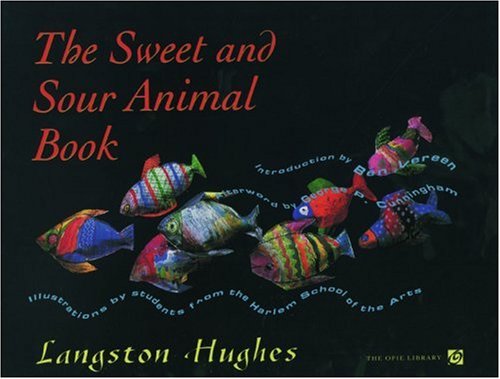


The Pasteboard Bandit attempts to do for Mexico what Popo and Fifina does for Haiti, but without the strength of Popo and Fifina's journey from the village to the city and from childhood to more adult responsibilities. The Sweet and Sour Animal Book, are short poems which most interestingly are illustrated by children from the Harlem School of the Arts.

There remain several other Hughes manuscripts for children, but as of now there are no plans for future publications.

All images are copyrighted © and owned by their respective holders.

Tuesday, November 2, 2010

LANGSTON HUGHES: THE STORY OF JAZZ

ON THE FINAL PAGE OF THE FIRST BOOK OF JAZZ by Langston Hughes, just below the photograph credits, the following announcement appears:
"The Story of Jazz, conceived and narrated by Langston Hughes. Folkways FP712. As Langston Hughes tells his story of jazz, authentic recordings illustrate the rhythmic drums, the field hollers, the French songs and bands and early jazz of New Orleans, the blues, ragtime--everything that has gone into the making of jazz. A vivid presentation, based on The First Book of Jazz."
Hughes recorded several albums for Moses Asch's Folkways label. Most of them are recordings of Hughes reciting his poetry such as The Dreamkeeper and Other Poems by Langston Hughes (1955), a collection that had appeared in book form in 1932 aimed at a children's market. One of his first records though, was a 10" children's record meant as a companion to The First Book of Jazz entitled The Story of Jazz (1954). As the above advertisement promises, Hughes in a relaxed, self-confident narration weaves the story of jazz with the music itself.

Below are links to the three tracks that comprise The Story of Jazz. The links should take you to a download page on the file sharing site 4shared. This is the first time I am using 4shared, so please let me know if you have any problems downloading the tracks. To create the WAV files, I simply played the vinyl record straight through and captured the sound using Audacity. I made no further alterations outside of breaking the recording into the three tracks as listed on the album's label.

Track 1: Beginnings
Track 2: The Blues
Track 3: Characteristics

The liner notes contain the complete text of Hughes's narration along with photographs and music credits. In order to read along, click on the images below to see them original size.


The Story of Jazz was successful enough that Hughes went back and made a companion record to his earlier book The First Book of Rhythm called Rhythms of the World (1955). I have yet to get my hands on a copy of Rhythms of the World, but if the response for The Story of Jazz is good, I'll try to post Rhythms of the World as well. For now, an excerpt from Rhythms of the World appears on the Smithsonian Folkways CD The Voice of Langston Hughes. Please let me know what you think.


Coming soon: Cliff Roberts

UPDATE (10/18/2011): Several of you have written to let me know that the audio files above are no longer available through my links. 4shared only stores files for a limited amount of time after long inactivity. I've been meaning to get these files back up somehow, but haven't had a chance. For those really interested, Smithsonian Folkways will make a custom on-demand CD of any album in their catalog. You can buy "The Story of Jazz" on their website here for $16.98.

Hughes's other children's record to accompany The First Book of Rhythms called Rhythms of the World can also be ordered as a custom on-demand CD on their website here, also for $16.98.

All images and recordings are copyrighted © and owned by their respective holders.

Monday, November 1, 2010

LANGSTON HUGHES: THE FIRST BOOK OF JAZZ

FOR LANGSTON HUGHES'S THIRD ENTRY in the First Books series, he turned his attention to a subject that was of great importance to him: jazz. It was the first children's book to examine the "American music," and Hughes felt the responsibility. As he wrote in a letter to Arna Bontemps,  "what I really know about Jazz would fill a thimble!," and so he made sure that the text was reviewed by Dave Martin, Marshall Stearns, John Hammond, and other jazz experts. To his editor Helen Hoke, he confessed that The First Book of Jazz was "just about the toughest little job I've ever done."

THE BOOK OPENS WITH LOUIS  ARMSTRONG who becomes the lens through which the history of jazz is revealed. Little Louis grew up in New Orleans, a town where everyone played music, often spontaneously and with abandon. "To the players, it is play--just for fun. That is how the music called jazz began--with people playing for fun."


Throughout the book, Hughes truthfully highlights African-Americans' role in the development of jazz music.
"A part of American music is jazz, born in the South. Woven into it in the Deep South were the rhythms of African drums that today make jazz music different from any other music in the world. Nobody else ever made jazz before we did. Jazz is American music."
Despite the patriotic tone, the particular Americans in question are undeniably black. In a photo spread of "Great Jazz Pianists" African-American musicians outnumber white seven to three. (The men to women ratio is seven to three as well, interestingly.) Even when Hughes covers the vast array of American styles that went into jazz, they tend to be (as they should be) black interpretations of each musical form.

Work Songs

Jubilees

The Blues

Ragtime

Boogie-woogie

Louis Armstrong's life story then kicks back in, because as Hughes states, "The story of Louis Armstrong is almost the whole story of orchestral jazz in America." Through Amrstrong, Hughes can move the story from New Orleans to Chicago to New York City to the world.

With the history done, Hughes then discusses the mechanics of jazz: improvisation, syncopation, percussion, rhythm, blue notes, tone color, harmony, break, riff, and continuing his theme ("It was not just playing music. It was playing--like a game--with music, for fun.") the joy of playing.

At the end of the book, Hughes provides three appendices that are of interest to any jazz fan: "Famous Jazz Musicians," "Suggested Records for Study (Part 1, Part 2)," and "100 of My Favorite Recordings (Part 1, Part 2)."

Hughes was so excited by his subject that he went to Folkways records and convinced them to put out a companion LP for The First Book of Jazz called The Story of Jazz, which I will post later this week.

I HAVE INCLUDED MANY of Cliff Robert's fantastic illustrations here, but to see all of Cliff Roberts's art for The First Book of Jazz, (including a phenomenal double spread and a realistic portrait of Louis Armstrong, see my Flickr set here. I will discuss Cliff Roberts in greater detail in a future post with lots more great art from other children's books.

Background material for this post came primarily from Volume Two of Arnold Rampersad's definitive biography The Life Of Langston Hughes: 1941-1967 I Dream A World.

For other books in the First Book series by Langston Hughes, see:

The First Book of Negroes
The First Book of Rhythms

Coming soon: Langston Hughes's The Story of Jazz

All images are copyrighted © and owned by their respective holders.

Monday, October 25, 2010

LANGSTON HUGHES: THE FIRST BOOK OF RHYTHMS


LANGSTON HUGHES'S SECOND BOOK for the Franklin Watts First Book series was The First Book of Rhythms (1954). Drawing heavily from a course Hughes taught at the Laboratory School in Chicago in 1949, The First Book of Rhythms traces rhythm in all of its forms, from a person's heartbeat to music to oceans and planets to trees and trains and sports. For Hughes, rhythm is all encompassing. Just a few of the chapters titles shows that: "The Rhythms of Nature," "Rhythms of Music," "Rhythms and Words," "Athletics," "Machines," "Rhythms in Daily Life," "Furniture," and in case you somehow missed his point, the final chapter, "This Wonderful World."


The book starts off as an interactive lesson. The child reader is asked to take up a pen or pencil and to try some exercises in written rhythms. "Rhythm comes from movement," Hughes teaches. And each person's movement is distinct, creating its individual rhythm.


There are scientific facts about how sound travels through air or the benefit of streamlined trains and cars, but much of the book reads like a prose poem, a celebration of life in the tradition of Walt Whitman who Hughes quotes in his chapter "Rhythms and Words." A sample of Hughes's prose:
"In growing things there is an endless variety of rhythm from the shaggy, pyramiding pine to the tall bare curve of a towering palm, from the trailing weeping willow to the organ cactus of the desert, from the straight loveliness of bamboo trees in the tropics to the wind-shaped cypress of the California coast, clinging to a rocky cliff near the sea where the waves shower their salty spray."
There are the adjectives, the alliteration, and of course the rhythm that would be found in any of Hughes's poems.


If anything, at times Hughes is too lyrical, too abstract, caught up in his song of the world, lists and lists that might benefit from more discussion.
"Knitting creates its own rhythmical patterns by the very way the needles work in wool. So does chain stitching, cross-stitching, or featherstitching in sewing...When mothers curl little girls' hair they simply put the hair into the rhythm of spirals. But curls do not look well on all girls. Each person should arrange her hair to suit the shape of her face..."
He seems to have lost his point.


But to Hughes, this was a serious subject. From a lecture the poet gave on teaching poetry: "The rhythms of poetry give continuity and pattern to words, to thoughts, strengthening them, adding the qualities of permanence, and relating the written word to the vast rhythm of life."

He ends the book: "Rhythm is something we share in common, you and I, with all the plants and animals and people in the world, and with the stars and moon and sun, and all the whole vast wonderful universe beyound this wonderful earth which is our home."

ROBIN KING, the illustrator of the first edition of The First Book of Rhythms, had already had at least two careers before illustrating Hughes's book and had at least two more careers afterwords. The son of an artist (and later television personality), King was rigorously schooled in the arts by his father. When he left high school in the Depression to earn some money, he worked for a newspaper, where he worked his way up to the art department, doing photo touch ups. When World War II broke out and King was turned away by the armed services for health reasons, he drew comic books for both Marvel and DC, which is what led him to children's books. During a radio interview in support of one of his children's books, the program director was taken with King's resonant voice, and King fell into a career as a radio announcer and later the voice over artist in numerous national ad campaigns, such as this one for Mighty Dog dog food.


King died this past summer. His obituary in the San Francisco Chronicle (from which this paragraph is cribbed) can be read here.

In 1995, Oxford University Press reissued Hughes's book as The Book of Rhythms with an introduction by Wynton Marsalis, illustrations by Matt Wawiorka (whose farm and blackbird pie appear above), and an afterward by Robert G. O'Meally. All of my background material comes from O'Meally's afterward.


To read the complete The First Book of Rhythms along with all of King's artwork, see my Flickr set here.


See also: The First Book of Negroes


Coming soon: Langston Hughes's The First Book of Jazz

All images are copyrighted © and owned by their respective holders.

Sunday, October 10, 2010

LANGSTON HUGHES: THE FIRST BOOK OF NEGROES

WHEN LANGSTON HUGHES CAME TO PROMINENCE as the premier African-American poet in the late 1920s and early 1930s, many of his poems expressed anger over the inequalities that African-Americans faced in society. Much of that anger sought resolution in socialist or communist terms, as was common in the African-American community of that time due to the Communists' emphasis on the equality of all people regardless of race. While Hughes never joined the Communist Party, it was easy to see where his sympathies lay. Consequently, when the anti-communist furor arose in the early 1950s, Hughes found himself a victim of discrimination as publishers removed his books from their lists (including his children's novel Popo and Fifina, which had remained in print for almost twenty years), speaking engagements disappeared, and offers of further work dwindled. His reputation as a left sympathizer culminated in an appearance before Senator Joseph McCarthy's Senate Permanent Subcommittee on Investigations, where Hughes was exonerated by distancing himself from his early writings and agreeing to cooperate with the Subcommittee in all ways.

During that period, with work drying up, Hughes found himself in serious financial trouble. He turned to writing nonfiction children's books as a way to make some money quickly, starting with The First Book of Negroes for Franklin Watts's First Book series. ("When boys and girls FIRST start asking why?...what?...and how? FIRST BOOKS are the first books to read on any subject.") Other books in the series included The First Book of Bees, The First Book of Space Travel, and The First Book of Eskimos, but The First Book of Negroes was the the first title about a group of people that focused on a race rather than a nationality or geographic region. While the book was written and published before Hughes's appearance before McCarthy, Franklin Watts had already required Hughes to write a statement indicating that he was not a communist, which Watts used in his press materials. The book deliberately makes no mention of W. E. B. Du Bois or Paul Robeson, prominent African-Americans who were strongly associated with communism. And while Hughes openly discusses the injustice of Jim Crowe law in the South, he goes out of his way to say that no problem, including Jim Crowe, could not be resolved by open discourse in a democratic society. Hughes even cited The First Book of Negroes in his testimony before McCarthy as evidence of his belief in America and Democracy. "By taking an interest in our government, and by treating our neighbors as we would like to be treated, each one of us can help make our country the most wonderful country in the world."

THE FIRST BOOK OF NEGROES uses as a frame narrative the story of "Terry Lane whose skin is brown as a walnut and whose hair is black and beautifully crinkly." Terry lives in Harlem, which means that he is able to go about freely, and that he goes to school with white and Puerto Rican children. "If Terry lived in the South he could not go to school with white children, nor could they go to school with him." Hughes goes on to describe Jim Crowe, which "seemed very silly to Terry."


Terry's grandmother came from the South (although she went to Fisk University "so she does not say 'ain't'"), and she tells folktales in the African-American oral tradition and knows many funny rhymes. Once a year Terry goes to visit his relatives in the South where they have to ride in the last train car and the benches and water fountains are marked WHITE and COLORED. Terry's grandmother explains that these inequalities are a holdover from slavery, but she assures him that not all white people wished the Negroes ill. Even in slavery time there were whites who "wanted Negroes to live happily and have the same rights as other Americans."

When Terry's cousin Charlene comes to visit him in New York, they go sightseeing. Charlene has never seen a revolving door, an escalator, or eaten in the same restaurant with white people (all things that seem to amaze her in equal proportions). Of course she knows how to milk a cow, ride a horse, and clip sheep, which Terry doesn't. But "to cap the climax of the wonders of the day, Mrs. Lane took her son and his cousin to luncheon at a most amazing restaurant called the Automat where people put nickels and dimes into slots in the wall, and little glass cases fly open, and there is the food inside...anything you wish!"


The chapters about Terry comprise about a third of the book. The rest of the chapters, whose names should give a clear sense of what they are each about are:
  • A Brave Explorer (Estevanico, who discovered what are "now Arizona and New Mexico" as the advance guard on a Spanish expedition in 1539)
  • Songs of Freedom: The Spirituals
  • Negroes in America Long Ago
  • Terry's Ancestors May Have Come from Many Places
  • The King's of History
  • Negroes Around the World
  • A Negro Saint (Martin de Porres of Peru)
  • American Negroes
  • Famous American Negroes (Frederick Douglas, Paul Laurence Dunbar, Thurgood Marshall)
  • The Story of Harriet Tubman
  • Well Known American Negro Women (Dr. Ruth Temple, Ethel Waters, Josephine Baker; Baker only appeared in the first printing because a New York reviewer threatened to pan the book on the belief that Baker was a communist.)
  • Golden Trumpets (on Louis Armstrong and jazz)
  • Old Satch (Satchel Paige)
  • Famous Negro Athletes (Jackie Robinson, Jesse Owens, Joe Louis)
  • Negro History Week
  • John Henry, Mighty Railroad Builder
  • More Famous American Negroes (Gwendolyn Brooks, Phillis Wheatley, Lena Horne)
The book ends with Terry's father taking him and his white friend David to skate at Rockefeller Plaza. On the way home, Terry declares, "'This is the prettiest city in the most wonderful country in the world,'" to which his father replies, "'I agree, it is good to live in America, Terry. Our country has many problems to solve, but...Here people are free to vote and work out their problems.'" The First Book of Negroes was published in 1952, two years before Brown vs. Board of Education, three years before the Montgomery Bus Boycott, and twelve years before the Civil Rights Act.


THE SPECTACULAR ILLUSTRATIONS throughout The First Book of Negroes are by Ursula Koering, who illustrated many books in the First Books series, and whose work I will discuss at greater length in a future post. To see all of Koering's art for The First Book of Negroes see my Flickr set here.

Background material for this post came primarily from Volume Two of Arnold Rampersad's definitive biography The Life Of Langston Hughes: 1941-1967 I Dream A World. I also consulted Tales for Little Rebels: A Collection of Radical Children's Literature edited by Julia L. Mickenberg and Philip Nell in which the chapter from The First Book of Negroes, "A Little Boy in a Big City," appears, and the afterward by Robert G. O'Meally to Oxford University Press's 1995 edition of The First Book of Rhythms.

Coming Soon: Arna Bontemps and Jack Conroy's Slappy Hooper: The Wonderful Sign Painter, illustrated by Ursula Koering


All images are copyrighted © and owned by their respective holders.

Tuesday, October 5, 2010

LANGSTON HUGHES AND ARNA BONTEMPS: POPO AND FIFINA

IN 1902, two almost brothers unrelated by blood and unknown to each other were born eight and a half months apart. James Mercer Langston Hughes was born in Joplin, Missouri on February 1, the son of two parents of mixed race whose own parents were of mixed race. Arnaud "Arna" Wendell Bontemps was born in Alexandria, Louisiana on October 13 to a black middle class family. By grade school Hughes was living in Lincoln, Illinois and Bontemps was living in the Watts section of Los Angeles, California. And by 1924, both men had found their way to Harlem, New York City, both with the ambition to become great poets, and both to become central members of the Harlem Renaissance.

At twenty-two, Hughes was already an acclaimed poet in the black community for his poems in The Crisis, the official magazine of the National Association for the Advancement of Colored People (NAACP). Bontemps had had poems published in The Crisis just that year. The two men looked so much alike that they were often mistaken for one another. (A quick look at their photographs on Wikipedia--Hughes, Bontemps--shows that clearly.) And when they met they had an instant affinity to each other. Hughes left Harlem for Washington D.C. days after they met, but Bontemps came and visited him in D.C., as Hughes would later visit Bontemps in the early thirties in Huntsville, Alabama where Bontemps had a teaching position at a college there. They corresponded frequently, a correspondence that would eventually reach over 2,500 letters by the time of Hughes's death.

It was at that Alabama visit in 1931 that Hughes and Bontemps initiated their first collaboration and the only one to be published in their lifetimes, a children's novel, Popo and Fifina: Children of Haiti. By then, Hughes had published three books of poetry and a book of fiction, and Bontemps had published a novel, but neither of them had yet written for children.

POPO AND FIFINA IS IN MANY WAYS A TRAVEL BOOK IN NOVEL FORM. The New York Times called it just that, and it has a lot in common with Hughes's later children's book The First Book of the West Indies (to be discussed in a future post). The story follows a brother and a sister (with more focus on the brother) as they move with their family from a small inland village to the larger town of Cape Haiti.


When they arrive in town, we are treated to a child's view of Cape Haiti. There are so many people! Men with parrots on their shoulders. Women with baskets on their heads. Children hawking candy. And the ocean! So much water.

Popo and Fifina's mother sets about making their new home while their father secures a position as a fisherman on one of the many fishing boats that go out each day. The children do their best to be helpful in any way they can, Fifina assisting her mother in making beds on the floor while Popo finds kindling for their fire.

Each detail is meant to expose an American audience to the dusty existence that is Haiti. Popo lives naked. A penny for candy is too much. The women wash with reeds, soap too expensive. The children must work. Even with these details of poverty, the family is never depicted as anything but happy, their lives full.

In order for Hughes and Bontemps to show village life as well as town life, after several weeks the children return to their home village with their mother. There, life is a large family, the taste of mangoes fresh off trees, and the nighttime ritual of drums.

Back in Cape Haiti, Popo's parents announce that it is time for the eight-year-old to get a job. He is fortunate enough to be granted an apprentice position in an uncle's woodworking business. Popo devotes himself to the craft, working with diligence and without pause on the first job given him, the carving of a tray, which he decorates with a sailboat, a promising show at a career.

Still the children's lives are not all work. Their father builds them a kite, which they fly on the beach. And the book ends with a family trip out to a lighthouse that is a joyous release even as it begins to rain.

LANGSTON HUGHES HAD LIVED IN HAITI for three months in the middle of 1931, where he made an effort to befriend members of all classes, taking copious notes and gaining access to aspects of Haitian culture usually closed to foreigners (such as the drum ritual depicted in the novel). He had come back outraged at the nation's poverty, and especially by the existence of an American marine base of questionable legality. (The treaty that allowed the marines occupation was never ratified by Congress.) Despite this impression, Hughes and Bontemps managed to quell their left leaning politics to make an endearing children's book, which was both a critical and commercial success, staying in print for over twenty years.

PERHAPS THE MOST ARRESTING FEATURE of Popo and Fifina are the spectacular woodblock prints made by E. Simms Campbell. Campbell was the first African-American artist to get work from a national magazine--Esquire where he designed their mascot--and the first African-American to have a nationally syndicated comic strip. Tomorrow, I will post excerpts from an Arna Bontemps essay on Campbell from We Have Tomorrow, a book on prominent African-Americans, as well as other examples of Campbell's work. Here, however, I want to include by way of comparison an image from Campbell's own Impressions of Haiti in a 1936 issue of Esquire.


To see all of E. Simms Campbell's illustrations for Popo and Fifina, see my Flickr set here.

Background material on Langston Hughes and Arna Bontemps comes from Volume One of Arnold Rampersad's definitive biography The Life of Langston Hughes, and from Rampersad's introduction and afterward to a 1993 Oxford University Press edition of Popo and Fifina, which is now also out of print.

Tomorrow: E. Simms Campbell.

UPDATE: A friend informs me that Oxford University Press currently has a paperback edition of Popo and Fifina in print and available on Amazon. I encourage everyone to buy a copy.

All images are copyrighted © and owned by their respective holders.