Showing posts with label Eugène Ionesco. Show all posts

Monday, March 5, 2012

INTERVIEW: ETIENNE DELESSERT

THIS IS THE MOST EXCITING THING that has grown out of We Too Were Children, Mr. Barrie. In September of 2011, I received a one-line email from Etienne Delessert, the illustrator of Eugène Ionesco's children's books, among many other things. He was unhappy with the way I had handled Ionesco's books in my original posts, in particular with the inclusion of later illustrators' works alongside his own. As detailed as I try to be in my research, I knew almost nothing about the books' original publisher Harlin Quist, or that Ionesco and Mr. Delessert had a falling out with him so severe that they abandoned plans to complete the last two of the four books that had originally been contracted. I invited Mr. Delessert to clear up any inaccuracies in my posts, and agreed to move the bulk of the other illustrators' works to my Flickr account. Now, Mr. Delessert has been kind enough to answer some of my questions about the Ionesco books, which will be re-published in his approved form this May by McSweeney's McMullens. All of Mr. Delessert's responses are presented here exactly as he emailed them to me, and should not be considered reflective of my opinion or the official position of We Too Were Children, Mr. Barrie.

WTWC: Why didn't you illustrate the final two Ionesco books for Quist?

DELESSERT: Quist was a talented editor and a terrible publisher. He was proud of being some kind of Don Quixote, battling the Big Houses...with a small team of an art director and an assistant. Later he expanded to France and had there a partner named François Ruy-Vidal. Both were real, vicious crooks.

I did four books with him: The Tree, that I wrote and was illustrated by Eleonore Schmid, The Endless Party, a very laic Noah's story, and the two first stories by Eugene Ionesco. Then we realized we would never be paid for all the reprints, and worldwide co-editions. Printers and photoengravers were not paid either. We were used as decoys to convince other artists and writers to work with Quist. So Ionesco and I decided not to continue anymore, even if we had a contract for the full four stories.

The Ionesco collaboration started one day at 5 PM on an overcrowded 42nd Street in New York, near Grand Central: Quist asked me what I wanted to do after The Endless Party, suggesting I could perhaps also illustrate someone else's text.

--Bring me a manuscript of Beckett or Ionesco, I told him. He was quite startled, I remember, but two weeks later he presented my work to Ionesco in Paris. That did it. Ionesco never had written stories for children...

In fact I had thought that Eugène was going to write a long story, perhaps a modern equivalent of  Alice in Wonderland, and was surprised, almost disappointed when we got the four very short texts.
I had at first no idea on how to illustrate them. I picked one of them as the first one, just because I felt there was more potential for a visual interpretation... Story Number1 became the first book of the series almost by chance.

It's only when I saw the possibility that the Jacqueline characters could not only have the same name (a world of  Jacqueline...) but could also look the same that I understood how to stage the book.
I gave to the book a very cinematic rhythm. Sometimes you need images and dialogue, sometimes the story is carried only by the pictures: it was quite revolutionary at the time. Sendak or Ungerer can write wild stories, but they follow the text quite closely with their pictures (except for the rumpus of the Monsters in the Wild Things book).

The Endless Party, with all the animals and their eyes looking at you, and Story Number 1 went around the world, and had a real impact. They are considered in Europe especially, as the roots, with Where the Wild Things Are and The Three Robbers by Tomi Ungerer, of the revolution in the picture book field that began in the 1970s.

It took me forty years to finish the work, and four years ago, it was quite a challenge to go back to the same characters, the same situations of a father (Ionesco himself) telling zany stories to his little daughter, with the idea of publishing the four stories in one book with Gallimard, in France. I am happy that McSweeneys picked the book up, and will issue it this Spring, at last, in the States. I was finally going back to a fresh interpretation of the stories.

I believe that any "pirate" edition that was published, way back, by the same Quist denatured totally the spirit of Ionesco's texts.


WTWC: Why was Quist allowed to go on and use other illustrators, and to even reissue the first two books with new illustrations?

DELESSERT: After Story Number 2 was published, Quist broke the contract, without asking Ionesco or me, and instead of cleaning up his act, decided to give the illustrations to new artists, who made people believe that they did not know the ugliness of the scheme!  Quist books had such a good reputation with critics and the public at the time, that artists were begging to be part of the group, even when they were warned about the perils of the venture. For me they were "collaborators" in the worst sense of the Second World War. Nobody was paid either...

WTWC: What were your feelings about your experience with Quist? What were Ionesco's?

DELESSERT: Great at the beginning. Quist was a charmer. For the first two or three years: the small group of artists was quite close. For instance, Eleonore Schmid, Rick Schreiter and I were meeting each week to exchange our experiences and dream about conquering the children's book field.
Eleonore and I were also working for magazines and some advertising, so we were able to keep going without the income of successful books, but Rick, already quite unstable, was completely broken by the Quist gang. He was one of the really great new original talents, but soon disappeared to become a homeless. Thanks Harlin and Ruy Vidal. Neither Ionesco or myself ever forgave them.
Like Boris Vian wrote:"J'irai cracher sur vos tombes!"

WTWC: What were your feelings about the reviews?

DELESSERT: Reviews were mixed: Sendak wrote that Stories 1 and 2 were some of the most original books of the decade. Some reviewers did not get it at all, just like now: intelligent criticism does not shine in the States...Some critics felt that the fact that a great playwright would write for children meant that the books were not for children! Reviews were better abroad.

That encouraged me to visit Jean Piaget to ask for his opinion. Not only did he reassure me, but he realized that over the years he had analyzed thousands of drawings by children, but never asked how children read and understand an image made by an adult. So we worked together for  eight months (in Switzerland, with a team headed by Odile Mosimann, visiting and interviewing classes) and came up with the picture book called How the Mouse Was Hit On the Head By a Stone and So Discovered the World. Piaget wrote the foreword. Published by Good Book (my imprint) and Doubleday, the book had also many co-editions. At that point, the venture even made French artists and writers tremble: would the publishers test their work before publishing it? Funny...

WTWC: If the stories were written for Marie-France, what made Ionesco choose to publish them after she was an adult? Was it because of grandchildren?

DELESSERT: No grandchildren! Just, before I suggested it, he never thought about publishing these stories that he had kept in a notebook: it was his home theater, and Marie-France
had some great lines...

WTWC: I'm also a little confused about the order in which things were published in the U.S. versus France. In France, as near as I can tell from Amazon.fr, Story Number 3 and Story Number 4 were both illustrated by Philippe Corentin and Nicole Claveloux, but in the U.S. Corentin's illustrations were only used for Story Number 3. Why? And why weren't you able to illustrate the final two books in France? Were Quist and the French publishers bound together contractually?

DELESSERT: Cannot answer, it was a mess, and I tried not to see the books! Quist and his partner Ruy Vidal had world rights. Some of the paperbacks by Naprstek, an unknown
 artist, are really despicable. I discovered them only recently. They came and went fast, a long time ago.

Quist went back to the theater production he had come from (and where the money was invested and lost?) and died. Ruy Vidal went on to other empty publishing ventures, and now is retired, and spends his time in writing very, very long defamatory letters, quite well written.

A few years ago, I went to see a Sendak show at the Morgan Pierpont Library in New York. There were only two visitors in the room: Quist and I. We did not speak.

Ionesco and I tried to sue the thieves, but Quist was very clever at having shell companies, and we gave up.

For sure Stories 1, 2, 3, 4 by Eugene Ionesco and Etienne Delessert had a very, very strange life!


ABOVE IS A SNEAK PEEK AT THE DUST JACKET for the McSweeney's McMullens edition of Stories 1, 2, 3, 4 (courtesy of the publisher). The jacket will appear standard on the front, back, and spine (as at the top of the post), but will fold out to poster size to reveal the entire text of Story Number 3 and its illustrations (as seen here). Thank you to Brian McMullen (publisher and the brain behind the jacket design) for the image.

All images are copyrighted © and owned by their respective holders.


Tuesday, June 22, 2010

EUGENE IONESCO: STORY NUMBER 4

STORY NUMBER 4 is Eugène Ionesco's final children's book. Originally billed in Ionesco's memoir Present Past Past Present as "a tale for children less than three years old," in picture book form it became a story "for children of any age."


JOSETTE KNOCKS on her parents' door as she does every morning. Papa indulged his gastronomic vices a little too much the night before and does not want to get up. Mama is not there. "'Where is Mama?'" Josette wonders. "'She has gone to the country to see her Mama.'" Satisfied with this answer, Josette makes her usual demand: to hear a story.

But today, Papa is all business. He has to get ready for work. "He goes into the bathroom. He closes the bathroom door."


Josette demands to be let in. But Papa is washing. Papa is shaving.
'I want to come in, I want to see.'
Papa says: 'You cannot see me, because I am not in the bathroom anymore.'
Josette says (behind the door): 'Then where are you?'
Papa answers: 'I don't know. Look for me...'


Josette follows her father's directions to the dining room. He is not there. (But he's been able to shave some without interruption.) Next Josette's sent to the living room and the kitchen and instructed to look under tables and inside pots and pans and behind doors. (And papa shaves and dresses.) After having run about the apartment looking for her father (based on her fathers' called directions through the bathroom door), Papa at lasts steps out of the bathroom ready for the day.

Then Josette's mama arrives, and suddenly Josette awakes. Her morning game of hide-and-seek was a dream. She gets up and...

"She goes to the door of her parents' bedroom..."

IN 2009, an omnibus edition of all four stories was released with illustrations by Etienne Delessert. Since Delessert did not originally illustrate Story Number 3 or Story Number 4, I assume that the art for those tales was newly created, but I have not gotten my hands on a copy and there does not appear to be any plans to release it in English.


To see almost all of the art for Story Number 4 by Jean-Michel Nicollet, see my Flickr set here.

For more background on Eugène Ionesco and his other children's books, see my posts:

Story Number 1
Story Number 2
Story Number 3

All images are copyrighted © and owned by their respective holders.

Friday, June 18, 2010

EUGENE IONESCO: STORY NUMBER 3

THE CHILDREN'S LITERATURE SCHOLAR Selma G. Lanes reviewed Eugène Ionesco's Story Number 3 for The New York Times in a joint review with a book by former Ionesco illustrator Etienne Delessert, and Donald Barthelme's National Book Award winner The Slightly Irregular Fire Engine (a future We Too Were Children, Mr. Barrie entry). She found Delessert's book (a collaboration with Jean Piaget) to be an utter failure. Barthelme's book showed promise but was overall a disappointment. And Ionesco's book?
"With a rare gift for transforming trivia to poetry Ionesco holds us rapt as the tale's papa recites to his small daughter: 'We're going to take a trip in an airplane. So I put on your underpants, I put on your little skirt, I put on your undershirt, I put on your little pink sweater....' How sweet are the commonplaces of everyday existence! And how comforting to a child!"
The lulling rhythm of oral storytelling, complete with call and response between father and daughter, are just as pleasing to an adult. Perhaps it's not surprising that the dramatist Ionesco truly comes alive in his only children's book in the form of a dialogue.

"LITTLE JOSETTE--just as she had done the day before and just as she did every morning--knocked on the door of her parents' bedroom...."

Mama is already awake and in the bath, but Papa, who had gone out the night before for a round of restaurants, movies, and puppet shows, is still in bed. Josette climbs into bed with him, and demands a story.

"'We're going to take a trip in an airplane," Papa begins. And he describes how they will get ready to go out, the tidings Mama will give them, the warnings the maid Jacqueline will provide ("She must not lean out of the window; it's dangerous. She might fall."), and the trip out of the apartment to the street.


On the way out, the superintendant's wife will also warn Josette that she musn't lean out the window, lest she fall out.

They will pass the butcher's shop. "Josette hides her eyes: I don't want to look! Mean butcher!"


They will take the bus. They will arrive at the airport. "'We climb into the airplane. It goes up and up, see, just like my hand: vvrrr...'"

They will look out the window and see the neighbor's house. The cars will be tiny, as will the people, and the animals in the zoo. Papa pretends to be the lion in the zoo, but it scares Josette, so he reassures her that he is not a lion; he is Papa. Then they see friends and fields and the mayor's house and the steeple and the priest and the country, the windmill, the ducks, the fish in the water ("We don't eat nice fish; we eat only the bad fish."), "And then we go up, we go up, we go up...

And reach the moon. They each eat a piece of the moon. "It's delicious; it's made of melon." But they take to the airplane again, and continue on to the sun.


The sun is hot, so very hot. They want to return to earth, but it's so hot the airplane has melted. It's all right though, because they can walk back home just as well. They need to hurry or lunch will be cold.

"At that moment, mama comes in and says: 'Get up, get out of bed and dress yourselves.'"


WHEN STORY NUMBER 3 appeared in Ionesco's memoir Present Past Past Present it, like all four stories, was subtitled "Tale for Children Less Than Three Years Old." But when it appeared in picture book form (illustrated by Philippe Corentin), the subtitle had changed to "For children over three years of age." Why it was decided that Story Number 3 was for an older audience than Story Number 1 or Story Number 2 is unclear. Perhaps it is because Papa says, "If the butcher kills any more calves, I'm going to kill the butcher..." Or the repeated warning that Josette could fall out of the airplane and be hurt. Or simply that the nuance of an imagined story within the story, one that Josette fully participates in as a co-storyteller as well as a character, requires a more mature mind than when Papa tells a simple story as in the earlier two books. In any event, a reader (or listener) of any age will feel comforted (and amused) by Ionesco's masterful dialogue.

Coming Soon: Eugène Ionesco's Story Number 4.

All images are copyrighted © and owned by their respective holders.

Thursday, June 17, 2010

EUGENE IONESCO: STORY NUMBER 2

EUGENE IONESCO'S SECOND PICTURE BOOK, Story Number 2, appeared one year after the first. It again finds the young Josette knocking on her parents' bedroom door early in the morning. This time Papa and Mama stayed home the night before and are already awake. In fact, Mama has already gone out.

"Jacqueline [the maid] told Josette that her mama had just left the house, with her pink umbrella, her pink gloves, her pink shoes, her pink hat with flowers on the hat, her pink pocketbook with the little mirror in it, her beautiful flowered stockings, with a gorgeous bouquet of lowers in her hand."

So Josette seeks her papa, who is on the telephone in his home office, conducting an antagonistic call. When he hangs up and Josette asks if he is speaking on the telephone, Papa says, "'This is not a telephone.'"


Josette insists that it is. Everyone has told her so. Everyone is wrong. It is called a cheese. But then, what is cheese?

"'Cheese isn't called cheese. It's called music box. And the music box is called a rug. The is called a lamp. The ceiling is called floor. The floor is called ceiling. The wall is called a door.'"


"So papa teaches Josette the real meaning of words."

Jacqueline, that champion of reality, enters and immediately starts an argument with Papa as to who is speaking correctly and who is saying the opposite. Josette believes they are actually in agreement.

"Suddenly mama arrives, like a flower." She has been out gathering flowers. "And Josette says, 'Mama, you opened the wall.'"

BARBARA NOVAK, IN HER NEW YORK TIMES REVIEW, considered Story Number 2 to be a saving grace in a children's book market that had become simple-minded and banal.
It is the most natural thing in the world for Ionesco to write for children. The reversal of usual relationships, the fantasy, the credibility he donates to the incredible, along with the sheer delight in nonsense, all are more readily assimilable by children than by their elders.
She concludes, "Ionesco, you are welcome to picture book land."

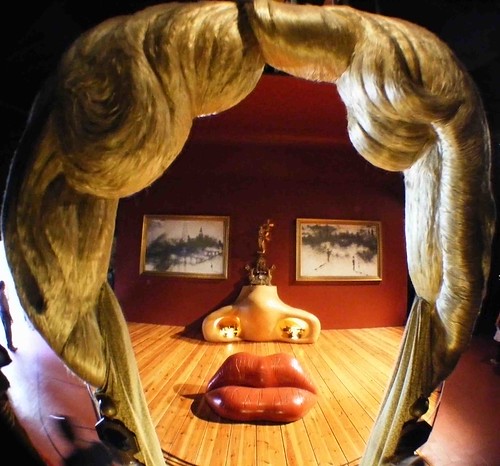
Despite such a laudatory review, Story Number 2 is rather slight, devoid as it is of story, and with word play that is no more than substitution, not the delightful nonsense of Dr. Seuss or Edward Lear. Delessert's surrealistic images have little to do with the text, which is in some ways their strength, adding a second set of symbols beside Ionesco's. Gerard Failly's illustrations for the 1978 edition makes the connection to the surrealists explicit in his final image for the book of Josette's mother...


...which is a tribute to Salvador Dalí's Mae West.


For other Failly illustrations, see my Flickr set here.

Coming Soon: Eugène Ionesco's Story Number 3.

All images are copyrighted © and owned by their respective holders.

Wednesday, June 16, 2010

EUGENE IONESCO: STORY NUMBER 1

IN 1968, EUGENE IONESCO RELEASED "a personal memoir" entitled Present Past Past Present. It was a collection of memories presented in short passages that flowed easily from childhood to adulthood. 1967 sat beside 1940. His earliest memories were paired with memories of his daughter as a toddler. And sandwiched between these often dark and brooding reminiscences were four light stories "for children less than three years old" simply numbered Story Number 1, Story Number 2, Story Number 3, and Story Number 4.

At the time the memoir appeared, Ionesco was one of the towers of theater. His biting satires eschewed straight narrative--in fact, they often seemed to be a sequence of non sequiturs--and concerned themselves with the philosophical questions of the relationships between the individual and the state, the individual and reality, and the individual and death. His most famous play Rhinoceros premiered in 1959. It is the story of a small town in which all of the inhabitants but one turn into rhinoceroses, Ionesco's symbol for a person with blind faith in the state. Two years later, the critic Martin Esslin included Ionesco in a group of playwrights--along with Samuel Beckett, Jean Genet, and Arthur Adamov--who practiced what he called the Theater of the Absurd, plays that address Albert Camus's discussion in The Myth of Sisyphus that man's search for meaning and order in life is futile. For a writer usually engaged in such heady topics, Ionesco's children's stories, jammed as they were in his memoir, seem somewhat out of place.

Which is perhaps why they were immediately excised from the memoir and released in the form of picture books. Story Number 1 was published by Harlin Quist in the same year as Present Past Past Present.

"JOSETTE IS THIRTY-THREE MONTHS OLD, and she is already a big girl." Every morning she creeps to her parents room to wake them, and on this particular morning, Josette's parents are hungover in bed after a night of nightclubs and restaurants. This is of course lost on Josette, but not on the maid Jacqueline, who in annoyance at her employers' laziness pushes her way into the room with an overladen breakfast tray.

Father orders Josette and Jacquline away, and the two retire to the kitchen where they devour Papa and Mama's food.

This doesn't put Josette off for long. She returns to the bedroom where she demands a story from Papa. "And while mama sleeps (because she is exhausted from having celebrated too much), papa tells Josette a story."

There was once a little girl named Jacqueline. She had a papa named Jacqueline and a mama named Jacqueline, and sisters, cousins, aunts, uncles, friends, toys, in short, everyone in her life was named Jacqueline too.


Papa's story does not progress much beyond that. And soon the real Jacqueline puts an end to it as utter nonsense.

Instead Jacqueline takes Josette with her to do the day's shopping.

At the market, Josette meets a girl whose name happens to be Jacqueline. She immediately informs the girl, to the horror of all of the customers, that she knows all about it. Jacqueline has a papa named Jacqueline, a mama named Jacqueline, a little brother named Jacqueline...

Once again the real Jacqueline steps in to assert reality. She addresses all of the customers who look at Josette "with big, frightened eyes."

"'It's nothing,' the maid says calmly. 'Don't be upset. These are just the silly stories her papa tells her.'"

ALL FOUR OF IONESCO'S CHILDREN'S STORIES are often said to have been written for his daughter Marie-France. If that is the case, they were likely written in 1946 or '47 as Marie-France was born in 1944. Why Ionesco would let twenty years pass before publishing the stories, or in that case, why he would chose at that late date to publish the stories at all is unclear. I suspect it is more likely that they were written for a granddaughter, but I have been unable to find if Ionesco had a granddaughter. If anyone has more definitive information, please share.

IN A 1971 ADVERTISEMENT for the first two of Ionesco's children books, a prominent blurb reads, "Ionesco's poker-faced absurdities and Delessert's uncanny illustrations reflect the interior world of childhood with immense originality. Their Story Number 1 and Story Number 2 must be considered among the most imaginative picture books of the last decade." The source of that blurb? Maurice Sendak. I'm sure he was not at all swayed by one of Delessert's surreal illustrations in which there is a cameo of a certain wild thing.


IN 1978, Harlin Quist published a second edition of Story Number 1 illustrated by Joel Naprstek. To see all of Naprstek's illustrations, visit my Flickr set here.


Coming Soon: Eugène Ionesco's Story Number 2.

All images are copyrighted © and owned by their respective holders.