LONG TIME READERS might remember a series I did almost two and a half years ago on Gertrude Stein's children's book The World Is Round. There have been many editions over the years, in many different formats, with different illustrations, all of which I examined then, all of which were out of print. But now thanks to Harper Design, The World is Round is back in print in a 75th Anniversary Edition that features the original illustrations, complete with pink paper and blue text, on nice, heavy paper stock. Illustrator Clement Hurd's son Thacher Hurd, who is also a children's book writer and illustrator, provides a new foreword detailing the publication history of the book along with reminiscences of his father at work. But more importantly, Edith Thacher Hurd's afterword, which originally appeared in a limited collector's edition in 1986 is included, containing correspondence between Hurd and Stein during the creation of the book. The only thing I would have liked to see in addition are samples of Hurd's redrawn illustrations for the 1966 edition, but that criticism is extremely nitpicky. In DVD terms, this is really the Special Edition with Bonus Features, and I highly recommend it to anyone interested in Stein's children's book.
All images are copyrighted © and owned by their respective holders.
Being a Compendium of Children’s Books by Twentieth
Century “Adult” Authors Currently Out of Print
Tuesday, October 8, 2013
Friday, August 16, 2013
PATRICK EATS HIS PEAS BY GEOFFREY HAYES
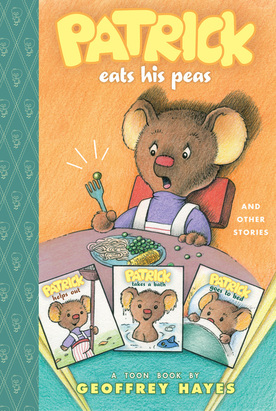
REVIEWING NEW BOOKS is a little off topic for We Too Were Children, but I've been so negligent in my blogging that when my friends over at TOON Books asked if I would review one of their newest releases, I said yes. Better something on the blog than nothing, I figured. And it didn't hurt that it was the new Geoffrey Hayes book, because I love Geoffrey Hayes. So I hope you don't mind taking a look with me at his latest, Patrick Eats His Peas and Other Stories.
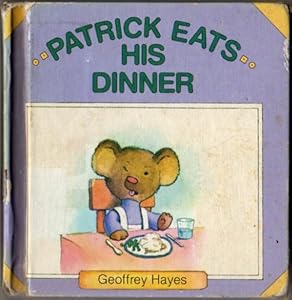
Geoffrey Hayes has been making children's books since 1976, and has over forty titles to his credit. His first book, a picture book entitled Bear By Himself, introduced the appropriately-named character Bear, as he enjoyed a quiet day alone. When Bear appeared again two years later, it was in a book that was over one hundred pages and contained five stories, only now Bear had a name: Patrick. This sudden shift in format was one Patrick would undergo several times as Hayes moved the character from publisher to publisher over the years. Patrick sometimes appeared in a picture book, sometimes in a 8x8 book formatted for a spinner rack, other times as a board book, and most recently in comics. Through each of these incarnations, Hayes often reused stories that had appeared in earlier incarnations, sometimes redrawing the stories from scratch. (See the 1976 and the 1998 editions of Bear By Himself, and the 1989 book Patrick Eats His Dinner below.) With the success of his Benny and Penny comics for TOON Books, it was no surprise that Patrick again followed Hayes to a new publisher and a new format, in a mix of redrawn stories and new ones.

But before Patrick ventured into comics, Hayes garnered critical acclaim (including a Theodor Seuss Geisel Award) for his first foray into the form, his series for young readers Benny and Penny. The Benny and Penny books are masterpieces. Hayes's ability to capture the anxieties, the travails of socialization, and the tribulations of very young children is mind-blowing. Benny and Penny are brother and sister, and their stories take place for the most part in their backyard. They must negotiate playing with each other, meeting new neighbors, playing with friends they don't really like, and braving the dark, all of which they do without adult supervision. Mom is always nearby, and sometimes calls to them from off panel, but really Benny and Penny need to figure things out for themselves. By creating an adult-free world, Hayes allows for his characters and his readers to engage with these social anxieties at an emotional level, the way a child would, and so Benny and Penny and the reader must work through the problem, and find a moral solution. There's none of the heavy-handed guiding message that underpins so many children's picture books. Instead, we get children and situations that ring so true that both children and adults can identify with Benny and Penny, find comfort in recognizing their own insecurities, and learn the lesson by experience rather than by being taught.
The Patrick TOON books have the same verisimilitude as the Benny and Penny books, but for Patrick, his parents are an ever-present source of security. As a result, Patrick reads as a younger character (even though he gets sent to the store by himself in one of the stories), and his relationship with his parents--his mother in particular--is in some ways the main topic of the books. Yes, Patrick must contend with the childhood annoyances of taking a nap, taking a bath, eating his peas, and many other typical, "Aw, ma, do I have to..." scenarios, but with the exception of a bullying story in Patrick in A Teddy Bear's Picnic, the books are about the interactions between parent and child. The trick then becomes the balance between Patrick's perspective and his parents' perspective.
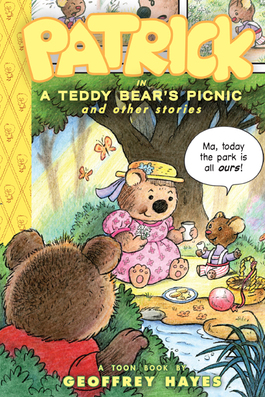
In Patrick in the Teddy Bear's Picnic, Hayes manages to tip the balance in Patrick's favor. Mom is there, and a parent reader can recognize her amusement and annoyance at some of Patrick's foibles, but Patrick's experience is the one that both the adult and child reader identifies with. This is in part because Patrick is alone in more of the book than he is in Patrick Eats His Peas. He retrieves a balloon at the park, endures nap time, and takes the aforementioned trip to the store. But it is mainly because Mom's actions are the way in which a child would experience them. She is on the sidelines, almost always placid, happy, and comforting, except for rare, and brief, bursts of annoyance. The focus is on what Patrick is feeling, and Mom, as far as he sees it, is just there as a source of support.
In Patrick Eats His Peas, however, the balance tips in the parents' favor, and the book is less satisfying. Here Patrick makes a mess of the leaves his father has just raked, offers similar "help" to his mother in the kitchen, trashes the bathroom during his bath, and insists on making fudge at bedtime. At each of these points, Mom and Dad's expression is highlighted, usually given a full panel to the parent alone, and often in classic cartoon style, with shock lines radiating from her head. This makes the moments feel more like parental observations, than children's conflict. The point seems to be, "Isn't it frustrating (or amusing) when your kid does this?" instead of tackling what Patrick is feeling. In the case of Patrick offering help in the yard and in the kitchen, for example, we don't get the loneliness and boredom of an only child whose parents are both busy. We get the parents' frustration at having their tasks hampered by Patrick's "help." In the end, it makes Patrick Eats His Peas a disappointment. Instead of the insightful parsing of the conflicts of childhood that Hayes is so good at, we get something closer to anecdotes. Is it a bad book? No. It's still Hayes, and therefore better than most children's books. It's just not in the same league as his other TOON books.
All images are copyrighted © and owned by their respective holders
Geoffrey Hayes has been making children's books since 1976, and has over forty titles to his credit. His first book, a picture book entitled Bear By Himself, introduced the appropriately-named character Bear, as he enjoyed a quiet day alone. When Bear appeared again two years later, it was in a book that was over one hundred pages and contained five stories, only now Bear had a name: Patrick. This sudden shift in format was one Patrick would undergo several times as Hayes moved the character from publisher to publisher over the years. Patrick sometimes appeared in a picture book, sometimes in a 8x8 book formatted for a spinner rack, other times as a board book, and most recently in comics. Through each of these incarnations, Hayes often reused stories that had appeared in earlier incarnations, sometimes redrawing the stories from scratch. (See the 1976 and the 1998 editions of Bear By Himself, and the 1989 book Patrick Eats His Dinner below.) With the success of his Benny and Penny comics for TOON Books, it was no surprise that Patrick again followed Hayes to a new publisher and a new format, in a mix of redrawn stories and new ones.

But before Patrick ventured into comics, Hayes garnered critical acclaim (including a Theodor Seuss Geisel Award) for his first foray into the form, his series for young readers Benny and Penny. The Benny and Penny books are masterpieces. Hayes's ability to capture the anxieties, the travails of socialization, and the tribulations of very young children is mind-blowing. Benny and Penny are brother and sister, and their stories take place for the most part in their backyard. They must negotiate playing with each other, meeting new neighbors, playing with friends they don't really like, and braving the dark, all of which they do without adult supervision. Mom is always nearby, and sometimes calls to them from off panel, but really Benny and Penny need to figure things out for themselves. By creating an adult-free world, Hayes allows for his characters and his readers to engage with these social anxieties at an emotional level, the way a child would, and so Benny and Penny and the reader must work through the problem, and find a moral solution. There's none of the heavy-handed guiding message that underpins so many children's picture books. Instead, we get children and situations that ring so true that both children and adults can identify with Benny and Penny, find comfort in recognizing their own insecurities, and learn the lesson by experience rather than by being taught.
The Patrick TOON books have the same verisimilitude as the Benny and Penny books, but for Patrick, his parents are an ever-present source of security. As a result, Patrick reads as a younger character (even though he gets sent to the store by himself in one of the stories), and his relationship with his parents--his mother in particular--is in some ways the main topic of the books. Yes, Patrick must contend with the childhood annoyances of taking a nap, taking a bath, eating his peas, and many other typical, "Aw, ma, do I have to..." scenarios, but with the exception of a bullying story in Patrick in A Teddy Bear's Picnic, the books are about the interactions between parent and child. The trick then becomes the balance between Patrick's perspective and his parents' perspective.
In Patrick in the Teddy Bear's Picnic, Hayes manages to tip the balance in Patrick's favor. Mom is there, and a parent reader can recognize her amusement and annoyance at some of Patrick's foibles, but Patrick's experience is the one that both the adult and child reader identifies with. This is in part because Patrick is alone in more of the book than he is in Patrick Eats His Peas. He retrieves a balloon at the park, endures nap time, and takes the aforementioned trip to the store. But it is mainly because Mom's actions are the way in which a child would experience them. She is on the sidelines, almost always placid, happy, and comforting, except for rare, and brief, bursts of annoyance. The focus is on what Patrick is feeling, and Mom, as far as he sees it, is just there as a source of support.
In Patrick Eats His Peas, however, the balance tips in the parents' favor, and the book is less satisfying. Here Patrick makes a mess of the leaves his father has just raked, offers similar "help" to his mother in the kitchen, trashes the bathroom during his bath, and insists on making fudge at bedtime. At each of these points, Mom and Dad's expression is highlighted, usually given a full panel to the parent alone, and often in classic cartoon style, with shock lines radiating from her head. This makes the moments feel more like parental observations, than children's conflict. The point seems to be, "Isn't it frustrating (or amusing) when your kid does this?" instead of tackling what Patrick is feeling. In the case of Patrick offering help in the yard and in the kitchen, for example, we don't get the loneliness and boredom of an only child whose parents are both busy. We get the parents' frustration at having their tasks hampered by Patrick's "help." In the end, it makes Patrick Eats His Peas a disappointment. Instead of the insightful parsing of the conflicts of childhood that Hayes is so good at, we get something closer to anecdotes. Is it a bad book? No. It's still Hayes, and therefore better than most children's books. It's just not in the same league as his other TOON books.All images are copyrighted © and owned by their respective holders
Tuesday, July 30, 2013
THE LITTLE WOMAN WANTED NOISE BACK IN PRINT
ALMOST EXACTLY ONE YEAR AGO, I contributed a guest post to Vintage Kids' Books My Kid Loves on the book The Little Woman Wanted Noise by Val Teal with pictures by Robert Lawson. The people over at New York Review Books, who bring wonderful out-of-print books back into print, saw the post and loved what they saw, so they tracked down a copy for themselves. Then they got in touch with me and asked if I had any way of getting in touch with Val Teal's family. At the time, I didn't, but thanks to some internet sleuthing, I managed to actually get in touch with Val Teal's daughter, and to put her in touch with NYRB, and so now, today, a brand new, back-in-print copy of The Little Woman Wanted Noise arrived in the mail. Which means that all of you readers who have spent the last year pining after the book in my post (and those of you who haven't) can buy a new copy now! Well, in a few weeks, when the book is officially released on September 24, 2013. So pre-order! And enjoy.
All images are copyrighted © and owned by their respective holders.
Tuesday, May 7, 2013
SYLVIA PLATH: "THE BULL OF BENDYLAW"
NONE OF SYLVIA PLATH'S children's books were published in her lifetime, but she did see one children's poem in print: "The Bull of Bendylaw," which appeared in the April 1959 issue of The Horn Book Magazine.
The Horn Book is a bimonthly magazine devoted to the discussion of children's literature, along with reviews of children's books, acceptance speeches for major literary awards for children's writers and artists, and occasional poems and stories. The readership includes children's librarians, teachers, children's booksellers, and parents, all of whom use it as a guide for what to read and recommend to children. What that means is, any poem or story published in The Horn Book is likely to reach children through one of these authorities.
As I've discussed in my previous entries on Sylvia Plath, both Plath and her husband Ted Hughes were actively writing for children in the late 1950s. One of their interests was in folktales and ballads, and they each wrote poems drawn from those influences. When Horn Book editor Ruth Hill Viguers approached the couple, asking each to submit poems for consideration, they were able to send several animal poems, which drew on those traditional sources.
Viguers had heard of Plath through a neighbor, but it was when her own children came home from school to say that their English teacher, Mr. Crockett (who had also been Plath's high school teacher) had read Plath's work in class that she chose to reach out to the poet. Not long after meeting with Viguers, Plath sent her husband and her own submissions: "Both of us enjoy writing poems about birds, beasts, and fish, so we are enclosing one from each of us, about an otter and a goatsucker..." In a postscript, she adds "We're adding to the zoo a bull and a field of horses." Only the bull was accepted.
"The Bull of Bendylaw" draws on one of F. J. Child's ballads, and opens with the epigraph:
I owe this entire post to the article in the Horn Book from 2005 by Lissa Paul, "Writing Poetry for Children is a Curious Occupation": Ted Hughes and Sylvia Plath, which I have cited for all of my Plath entries. And while I did go and see the Horn Book in the library, I was not allowed to take it out, and so the image of the cover comes from the excellent Sylvia Plath website http://www.sylviaplath.info/.
All images are copyrighted © and owned by their respective holders.
The Horn Book is a bimonthly magazine devoted to the discussion of children's literature, along with reviews of children's books, acceptance speeches for major literary awards for children's writers and artists, and occasional poems and stories. The readership includes children's librarians, teachers, children's booksellers, and parents, all of whom use it as a guide for what to read and recommend to children. What that means is, any poem or story published in The Horn Book is likely to reach children through one of these authorities.
As I've discussed in my previous entries on Sylvia Plath, both Plath and her husband Ted Hughes were actively writing for children in the late 1950s. One of their interests was in folktales and ballads, and they each wrote poems drawn from those influences. When Horn Book editor Ruth Hill Viguers approached the couple, asking each to submit poems for consideration, they were able to send several animal poems, which drew on those traditional sources.
Viguers had heard of Plath through a neighbor, but it was when her own children came home from school to say that their English teacher, Mr. Crockett (who had also been Plath's high school teacher) had read Plath's work in class that she chose to reach out to the poet. Not long after meeting with Viguers, Plath sent her husband and her own submissions: "Both of us enjoy writing poems about birds, beasts, and fish, so we are enclosing one from each of us, about an otter and a goatsucker..." In a postscript, she adds "We're adding to the zoo a bull and a field of horses." Only the bull was accepted.
"The Bull of Bendylaw" draws on one of F. J. Child's ballads, and opens with the epigraph:
"The great bull of BendylawPlath, however, associates the bull with the sea, and in her poem "The black bull bellowed before the sea," and the sea breaks forth and floods the kingdom. Not only can the king's men not turn the bull or sea back, but in the end
Has broken his band and run awa,
And the king and a' his court
Canna turn that bull about."
"O the king's tidy acre is under the sea,The poem was later included in Plath's Collected Poems as the first poem in the 1959 section, where the epigraph is relegated to the notes at the back of the book, and so in the long run, the readership for the poem ended up being adults, but Plath and editor Viguers obviously saw the poem as one that could be shared with children, making it a footnote to any discussion of Plath's writing for children.
And the royal rose in the bull's belly,
And the bull on the king's highway."
I owe this entire post to the article in the Horn Book from 2005 by Lissa Paul, "Writing Poetry for Children is a Curious Occupation": Ted Hughes and Sylvia Plath, which I have cited for all of my Plath entries. And while I did go and see the Horn Book in the library, I was not allowed to take it out, and so the image of the cover comes from the excellent Sylvia Plath website http://www.sylviaplath.info/.
All images are copyrighted © and owned by their respective holders.
Wednesday, May 1, 2013
SYLVIA PLATH: MRS CHERRY'S KITCHEN
IN 2000, FABER & FABER launched Faber Children's Classics, a series of books with uniform trade dressings that included works such as The Complete Nonesense by Edward Lear, Old Possum's Book of Practical Cats by T. S. Eliot, and Peacock Pie by Walter de la Mare. In order to round out the list with some exclusive titles, Faber took advantage of the fact that some of its most well known writers had little known children's books. One of the first books in the series was Sylvia Plath's Collected Children's Stories, released in 2001.
The book is comprised of Plath's two previously released children's books, The Bed Book and The It-Doesn't-Matter Suit, along with a new story, Mrs. Cherry's Kitchen.
Mrs. Cherry's Kitchen was first sketched out in one of Plath's journal entries from either 1957 or 1958 (I have found conflicting dates, and can't find the quote in the 1982 release of Plath's published journals). As quoted by Lissa Paul in her 1995 Horn Book article on Plath's children's work:
MRS. CHERRY IS A DOMESTIC GODDESS, who has a great appreciation for her modern appliances. She says things like, "'Thanks to our fine, shiny toaster...It's made us golden-bown toast each day without fail all these years.'" These kind of statements make her appliances proud, but it turns out it's not enough to keep them content. Each wants to do a job that another appliance does.
Unbeknownst to Mrs. Cherry, her kitchen is helped along in its daily tasks by two kitchen pixies with "long, unpronounceable names," who call themselves Salt and Pepper.
When the appliances come to Salt and Pepper and tell them of their dream to trade jobs, the pixies don't think it's such a great idea. "'It would mean a lot of extra work for us,'" they say to each other, but "'If we don't satisfy the kitchen folk, they may go on strike and stop work altogether. And then where would Mrs. Cherry be.'"
So they give their consent. Of course, they have to wait for Mrs. Cherry to leave the kitchen, which she does rarely. At last, a little before lunch time on the day set for the change-about, Sunny and Bunny, the twins from next door, come to tell Mrs. Cherry that their cat Fudge Ripple has had kittens. Mrs. Cherry goes to see them.
"And Whizz! Whirr! Bang! Clang!" The shirts go into the oven, unbaked plum tarts go into the icebox, the coffee percolator swallows ice cream, the iron tries making waffles. Unsurprisingly, they all fail miserably. What's worse, Mr. Cherry comes home for lunch unexpectedly, and sees all of the appliances going haywire. He runs out in a fright.
Salt and Pepper set to work making everything right, and by the time Mrs. Cherry has returned with Mr. Cherry, the mess is cleaned up and everything is as it should be.
DAVID ROBERTS'S ILLUSTRATIONS throughout the Collected Stories are excellent, as can be seen by the examples here. Unfortunately Mrs. Cherry's Kitchen is the weakest of the stories in the book, and it makes sense that it has never warranted a separate book on its own.
The background information for this post came primarily from the Lissa Paul article, but also from the book Out of the Cradle Endlessly Rocking: Motherhood in Sylvia Plath's Works by Nephie Christodoulides. This post and yesterday's also owes much to http://www.sylviaplath.info/.
COMING SOON: Sylvia Plath's "The Bull of Bendylaw"
All images are copyrighted © and owned by their respective holders.
The book is comprised of Plath's two previously released children's books, The Bed Book and The It-Doesn't-Matter Suit, along with a new story, Mrs. Cherry's Kitchen.
Mrs. Cherry's Kitchen was first sketched out in one of Plath's journal entries from either 1957 or 1958 (I have found conflicting dates, and can't find the quote in the 1982 release of Plath's published journals). As quoted by Lissa Paul in her 1995 Horn Book article on Plath's children's work:
Plath submitted the story to the children's magazine Jack and Jill, which had previously published one of her husband Ted Hughes's stories, but she didn't have much faith in it. It was with disappointment, but not surprise that she recorded in her journal on January 26, 1958 that the magazine had rejected the story."Suddenly, Ted & I looked at things from our unborn children's point of view. Take gadgets: a modern pot & kettle story. Shiny modern gadgets are overspecialized--long to do others tasks. Toaster, iron, waffle-maker, refrigerator, egg beater, electric fry-pan, blender. One midnight fairies or equivalent grant wish to change-about. Iron wants to make waffles, dips point for dents; refrigerator tired of foods, decides to freeze clothes, toaster tired of toast, wants to bake fancy cake..."
MRS. CHERRY IS A DOMESTIC GODDESS, who has a great appreciation for her modern appliances. She says things like, "'Thanks to our fine, shiny toaster...It's made us golden-bown toast each day without fail all these years.'" These kind of statements make her appliances proud, but it turns out it's not enough to keep them content. Each wants to do a job that another appliance does.
Unbeknownst to Mrs. Cherry, her kitchen is helped along in its daily tasks by two kitchen pixies with "long, unpronounceable names," who call themselves Salt and Pepper.
When the appliances come to Salt and Pepper and tell them of their dream to trade jobs, the pixies don't think it's such a great idea. "'It would mean a lot of extra work for us,'" they say to each other, but "'If we don't satisfy the kitchen folk, they may go on strike and stop work altogether. And then where would Mrs. Cherry be.'"
"And Whizz! Whirr! Bang! Clang!" The shirts go into the oven, unbaked plum tarts go into the icebox, the coffee percolator swallows ice cream, the iron tries making waffles. Unsurprisingly, they all fail miserably. What's worse, Mr. Cherry comes home for lunch unexpectedly, and sees all of the appliances going haywire. He runs out in a fright.
Salt and Pepper set to work making everything right, and by the time Mrs. Cherry has returned with Mr. Cherry, the mess is cleaned up and everything is as it should be.
DAVID ROBERTS'S ILLUSTRATIONS throughout the Collected Stories are excellent, as can be seen by the examples here. Unfortunately Mrs. Cherry's Kitchen is the weakest of the stories in the book, and it makes sense that it has never warranted a separate book on its own.
COMING SOON: Sylvia Plath's "The Bull of Bendylaw"
All images are copyrighted © and owned by their respective holders.
Subscribe to:
Posts (Atom)
+-+001.jpg)


+-+001.jpg)