Tuesday, October 5, 2010

LANGSTON HUGHES AND ARNA BONTEMPS: POPO AND FIFINA

IN 1902, two almost brothers unrelated by blood and unknown to each other were born eight and a half months apart. James Mercer Langston Hughes was born in Joplin, Missouri on February 1, the son of two parents of mixed race whose own parents were of mixed race. Arnaud "Arna" Wendell Bontemps was born in Alexandria, Louisiana on October 13 to a black middle class family. By grade school Hughes was living in Lincoln, Illinois and Bontemps was living in the Watts section of Los Angeles, California. And by 1924, both men had found their way to Harlem, New York City, both with the ambition to become great poets, and both to become central members of the Harlem Renaissance.

At twenty-two, Hughes was already an acclaimed poet in the black community for his poems in The Crisis, the official magazine of the National Association for the Advancement of Colored People (NAACP). Bontemps had had poems published in The Crisis just that year. The two men looked so much alike that they were often mistaken for one another. (A quick look at their photographs on Wikipedia--Hughes, Bontemps--shows that clearly.) And when they met they had an instant affinity to each other. Hughes left Harlem for Washington D.C. days after they met, but Bontemps came and visited him in D.C., as Hughes would later visit Bontemps in the early thirties in Huntsville, Alabama where Bontemps had a teaching position at a college there. They corresponded frequently, a correspondence that would eventually reach over 2,500 letters by the time of Hughes's death.

It was at that Alabama visit in 1931 that Hughes and Bontemps initiated their first collaboration and the only one to be published in their lifetimes, a children's novel, Popo and Fifina: Children of Haiti. By then, Hughes had published three books of poetry and a book of fiction, and Bontemps had published a novel, but neither of them had yet written for children.

POPO AND FIFINA IS IN MANY WAYS A TRAVEL BOOK IN NOVEL FORM. The New York Times called it just that, and it has a lot in common with Hughes's later children's book The First Book of the West Indies (to be discussed in a future post). The story follows a brother and a sister (with more focus on the brother) as they move with their family from a small inland village to the larger town of Cape Haiti.


When they arrive in town, we are treated to a child's view of Cape Haiti. There are so many people! Men with parrots on their shoulders. Women with baskets on their heads. Children hawking candy. And the ocean! So much water.

Popo and Fifina's mother sets about making their new home while their father secures a position as a fisherman on one of the many fishing boats that go out each day. The children do their best to be helpful in any way they can, Fifina assisting her mother in making beds on the floor while Popo finds kindling for their fire.

Each detail is meant to expose an American audience to the dusty existence that is Haiti. Popo lives naked. A penny for candy is too much. The women wash with reeds, soap too expensive. The children must work. Even with these details of poverty, the family is never depicted as anything but happy, their lives full.

In order for Hughes and Bontemps to show village life as well as town life, after several weeks the children return to their home village with their mother. There, life is a large family, the taste of mangoes fresh off trees, and the nighttime ritual of drums.

Back in Cape Haiti, Popo's parents announce that it is time for the eight-year-old to get a job. He is fortunate enough to be granted an apprentice position in an uncle's woodworking business. Popo devotes himself to the craft, working with diligence and without pause on the first job given him, the carving of a tray, which he decorates with a sailboat, a promising show at a career.

Still the children's lives are not all work. Their father builds them a kite, which they fly on the beach. And the book ends with a family trip out to a lighthouse that is a joyous release even as it begins to rain.

LANGSTON HUGHES HAD LIVED IN HAITI for three months in the middle of 1931, where he made an effort to befriend members of all classes, taking copious notes and gaining access to aspects of Haitian culture usually closed to foreigners (such as the drum ritual depicted in the novel). He had come back outraged at the nation's poverty, and especially by the existence of an American marine base of questionable legality. (The treaty that allowed the marines occupation was never ratified by Congress.) Despite this impression, Hughes and Bontemps managed to quell their left leaning politics to make an endearing children's book, which was both a critical and commercial success, staying in print for over twenty years.

PERHAPS THE MOST ARRESTING FEATURE of Popo and Fifina are the spectacular woodblock prints made by E. Simms Campbell. Campbell was the first African-American artist to get work from a national magazine--Esquire where he designed their mascot--and the first African-American to have a nationally syndicated comic strip. Tomorrow, I will post excerpts from an Arna Bontemps essay on Campbell from We Have Tomorrow, a book on prominent African-Americans, as well as other examples of Campbell's work. Here, however, I want to include by way of comparison an image from Campbell's own Impressions of Haiti in a 1936 issue of Esquire.


To see all of E. Simms Campbell's illustrations for Popo and Fifina, see my Flickr set here.

Background material on Langston Hughes and Arna Bontemps comes from Volume One of Arnold Rampersad's definitive biography The Life of Langston Hughes, and from Rampersad's introduction and afterward to a 1993 Oxford University Press edition of Popo and Fifina, which is now also out of print.

Tomorrow: E. Simms Campbell.

UPDATE: A friend informs me that Oxford University Press currently has a paperback edition of Popo and Fifina in print and available on Amazon. I encourage everyone to buy a copy.

All images are copyrighted © and owned by their respective holders.

Thursday, September 16, 2010

JAMES JOYCE'S THE CAT AND THE DEVIL BACK IN PRINT!

MY VERY FIRST WE TOO WERE CHILDREN, MR. BARRIE POST was on James Joyce's letter-to-his-grandson-turned-picture-book The Cat and the Devil. The book has been illustrated and published two times, in 1964 with illustrations by Richard Erdoes and in 1981 in the US (1978 in France) illustrated by Roger Blachon. I received an email today from the Swiss publisher SJW Schweizerisches Jugendschriftenwerk that the Roger Blachon edition is now available in five languages including English. It doesn't appear to be listed on Amazon.com or Amazon.co.uk, but it can be ordered directly from SJW on their website here in the section Google translates as "Swiss youth written work". Their press information, including the below image, isn't in English, so I can't offer more. It's just good to see an out-of-print book getting a second chance.

Wednesday, September 15, 2010

TONI MORRISON'S OTHER CHILDREN'S BOOKS

AS PER THIS BLOG'S INTRODUCTION, We Too Were Children, Mr. Barrie limits itself to twentieth-century, out-of-print books. Toni Morrison's The Big Box, highlighted yesterday, meets those requirements as the text was first published in 1980 and the now-out-of-print book version appeared in 1999. Since then, however, Morrison has published eight more picture books (all but one in conjunction with her son Slade Morrison), some of which remain in print. As a result, instead of the in depth discussion you are used to on We Too Were Children, I provide here a cover gallery with a few tidbits of info. Books that are still in print are linked to Amazon and I encourage everyone to buy them, whether it's on Amazon or at some other store. (I don't have an Amazon storefront and make no money off of these purchases. The links are just for your convenience.) They are:

The Book of Mean People (2002) by Toni Morrison with Slade Morrison, illustrated by Pascal Lemaȋtre. Like The Big Box, The Book of Mean People came out of Slade Morrison's childhood musings, which Morrison jotted down and later shaped into this book.


Who's Got Game: The Ant or the Grasshopper? (2003) by Toni Morrison with Slade Morrison, illustrated by Pascal Lemaȋtre. The Who's Got Game series was signed by Scribner as a six book deal. The series must have underperformed since it ended after only three books, which interestingly were later collected in an omnibus edition. The Morrisons' newest book (see below) brought out under the Simon and Schuster imprint (who own Scribner) is The Hare and the Tortoise. The Who's Got Game? concept was dropped as was the comic book format and illustrator Pascal Lemaȋtre.


Who's Got Game: The Lion or the Mouse? (2003) by Toni Morrison with Slade Morrison, illustrated by Pascal Lemaȋtre.


Who's Got Game: Poppy or the Snake (2004) by Toni Morrison with Slade Morrison, illustrated by Pascal Lemaȋtre.


Remember: The Journey to School Integration (2004) by Toni Morrison, illustrated with photographs. Morrison writes: "Because remembering is the mind's first step toward understanding, this book is designed to take you on a journey through a time in American life when there was as much hate as there was love..."


Who's Got Game: Collected Edition (2007) by Toni Morrison with Slade Morrison, illustrated by Pascal Lemaȋtre. Collection of the three previous Who's Got Game? titles.


Toni Morrison reads the book herself on the audio edition, and it is well worth getting your hands on. She reads with such command and expression that the otherwise only okay poetry comes to life and sounds important. You might want to have a hard copy with you as the illustrations do help with the narrative, but it's not essential.


Peeny Butter Fudge (2009) by Toni Morrison with Slade Morrison, illustrated by Joe Cepeda. This is Morrison's most personal picture book, about grandchildren visiting their grandmother and getting into all kinds of mischief with Nana as accomplice. There is no ambiguity to this text, and as a result it is Morrison's most comfortable children's book, good for toddlers.


Little Cloud and Lady Wind (2010) by Toni Morrison with Slade Morrison, illustrated by Sean Qualls. Ambiguity returns in this book about freedom, individuality, and communal responsibility.


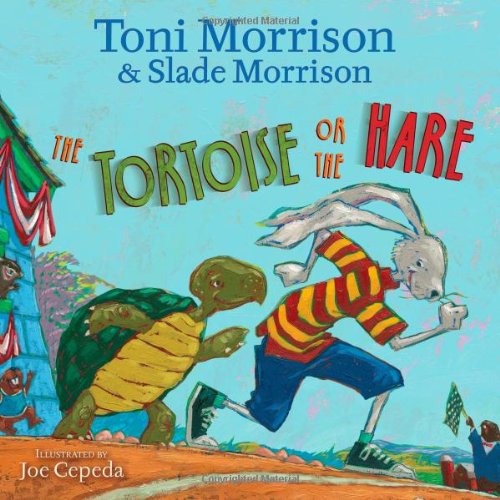
The Tortoise or the Hare (2010) by Toni Morrison with Slade Morrison, illustrated by Joe Cepeda. A return to Aesop.


At the rate she is currently publishing--sometimes two children's books a year--Nobel winner Morrison will end up leaving a more substantial body of children's picture books than novels

All images are copyrighted © and owned by their respective holders.

Tuesday, September 14, 2010

TONI MORRISON: THE BIG BOX

OF THE MANY WAYS that Ms. Magazine was groundbreaking, children's literature is not the first that comes to mind (if it comes to mind at all). But almost from its inception, Ms. Magazine included a feature called Stories For Free Children, stories for children meant as an alternative to the bulk of children's literature at the time that perpetuated stereotypes (often innocently) of gender roles, acceptable behavior, and traditional family life. One contributor, in the March 1980 issue, was Toni Morrison, author of Beloved (1987) and winner of the Nobel Prize for Literature in 1993.

Morrison shared her byline with her then fifteen-year-old son Slade Morrison. Slade had been told by a teacher that he "couldn't handle his freedom." The phrase troubled him, and he and his mother discussed it at length. It was out of those discussions that Toni Morrison composed her story for free children The Big Box.


THE BIG BOX is a troubling text in its ambiguity. It is the story of three kids who are kept in a gilded cage, because their parents, teachers, and neighbors don't know how to handle them. The big box is a room filled with such delights that it is unclear whether it is punitive or protective.
Patty and Mickey and Liza Sue
Live in a big brown box.
It has carpets and curtains and beanbag chairs.
And the door has three big locks.
 The first child, Patty, lives in a traditional suburban environment. Patty, however, talks in the library, sings in class, won't play with dolls, and is disrespectful to the American flag. As a result, it's decided that she "just can't handle [her] freedom."


When her sentence is handed down, she replies with what becomes the book's refrain,
"I know you are smart and I know that you think
You are doing what is best for me.
But if freedom is handled just your way
Then it's not my freedom or free."
Despite her plea, she is placed in the big box, locked away from the rest of society and the natural world, and visited by her parents only once a week. But at the same time, she has Barbie, Pepsi, a Princess phone, Nikes, a Spice Girls Shirt, "and a jar of genuine dirt." However, these material goods don't satisfy her longing to live her life as she wants to.


Mickey is a city boy who makes "the grown-ups nervous." His activities smack more of juvenile delinquency than Patty's--graffiti, sitting on the super's car--and so his sentencing to the big box doesn't seem as harsh, but still "he avoid[s] their eyes/By lowering his little boy head," and delivers the refrain that freedom the adult way is not freedom.

Mickey's possessions include Blimpies, Frisbees, comic books, Matchbox cars, "and a record that played exactly the sound/Made by a living seagull."

The last child, Liza, is a country girl (completing the triptych of settings) who lets "the chickens keep their eggs."  She is sentenced to the big box by "the neighbors who loved her," and joins Patty and Mickey in their toy filled room, her consolation "a film of a fresh running brook."


The book ends:
Oh, the porpoises scream
And the rabbits hop
And beavers chew trees when they need 'em
But Patty and Mickey and Liza Sue--

Who says they can't handle their freedom?
NINETEEN YEARS AFTER THE BIG BOX APPEARED in Ms. Magazine, the story was illustrated (by the wonderful Giselle Potter, whose illustrations appear above) and released as a picture book by Hyperion Books. Despite the proliferation of books celebrating diversity and the importance of being oneself in the intervening years, Morrison met with resistance when she wanted to bring the book out. She was told by one publisher that "We don't publish books in which the child at the end is not reconciled with the adult point of view." It didn't help that it remains unclear what point of view any of the children take.

One important clue might be found in the mission statement for Stories For Free Children. In a collection of the stories honoring the tenth anniversary of Ms. Magazine, editor Letty Cottin Pogrebin writes:
Very simply, you're a free child if you are allowed to be yourself and be true to yourself. That means being free to express the way you really feel, and to develop your own talents and follow your own honest interests without having to measure up to other people's ideas of what a girl or a boy is "supposed" to be.
(It should be of no surprise that one of Ms. Magazine's charter subscribers was Marlo Thomas who was inspired by this very column to compile under the auspices of the magazine the classic book and album Free to Be...You and Me (1972).

Interestingly, the book's copyright page makes no reference to Ms. Magazine even though the book text differs from the magazine text only in updating pop culture references--Pumas to Nikes, Farrah Fawcett to Spice Girls, a Jethro Tull poster to an autographed basketball. The one notable change, and perhaps another clue, is the addition of the final question at the end of the book. In the magazine the poem ends with the hyphen.)

Morrison, however, had more in mind than just self-expression, at least when the book version appeared in 1999. In response to the query, "what is The Big Box about?," Morrison replied:
The plight (and resistance) of children living in a wholly commercialized environment that equates "entertainment" with happiness, products with status, "things" with love, and that is terrified of the free (meaning un-commodified, unpurchaseable) imagination of the young.
In another interview she said:
I'm sort of in an environment in which I see the consequences of [shielding children from the world]. Teaching at Princeton and even where I was at Albany and Yale, I see the consequences of children when they are 17 and 18 years old who, by the time they get to university, their only job is to win; their job is to not fail. You keep wondering and you want to scratch them a little bit to see what's really underneath that enormous burden and commitment. And sometimes that pressure is too great for them because it's not about learning. And when you learn, you have to experiment and you have to sometimes make mistakes, but they aren't allowed to make mistakes. They're trained to do it right the first time.
Unsurprisingly, a book with such a subversive and critical subtext, was not received well by critics. The New York Times summed it up, "The Big Box resonates as a work of art, but it is not a book for children." Although, according to one interviewer, children dive into the questions posed by the book while adults are simply puzzled by it. Regardless of whether or not it is a book for children, despite its potential for academic discussion, The Big Box in the end is a rather mediocre book.

I consulted many sources for this post that included the academic papers Not Safe For the Nursery by Chia-yen Ku and Trust Them to Figure It Out by María Lourdes Lopez Ropero. But most important were an interview conducted by Rob Capriccioso, Toni Morrison's Challenge, and the interview provided by Hyperion Books for publicity that can be read on Barnes & Noble's page for the book on the "Features" tab.


All images are copyrighted © and owned by their respective holders.

Friday, September 10, 2010

INTRODUCTION UPDATE

WHEN I LAUNCHED We Too Were Children, Mr. Barrie, I said in the Introduction that my goal was to highlight one author a week. For the first several months I met that goal, and then, as frequent readers know, this plan was horribly derailed by a time-consuming move (that seems to have no end--shades in the library, anyone?; a functional workspace in the basement?...). I made a strong comeback with my long-in-the-works series on Graham Greene, but I haven't had time to even touch the stack of books that will eventually lead to future posts. My work has been further hindered by a loss of library privileges, which has made getting materials rather difficult (a situation I am trying to remedy). I know how crucial frequent updates are to a blog's life, and it's eating me up that my blog has been so stagnant. So to avoid any nagging concerns or disappointments (is he ever going to post again? should I cancel my subscription?), I set out here a revised goal:

We Too Were Children, Mr. Barrie will continue to be updated indefinitely. These updates, however, will appear on an erratic and unpredictable schedule that will always strive for the platonic ideal of a new author a week. Realistically this will probably mean one to two authors a month, although I hold firm to the belief that life will normalize sometime in the near future and I can go back to devoting the several hours a day the blog required at its peak.

Now that that's in digital print, I can feel less guilt and pressure, and you can readjust your expectations, and everyone will be pleasantly surprised and happy when another unearthed treasure graces this blog. Be assured, I am working towards completing an enormous project that will be good for several weeks of posts (assuming people have continued interest in this author), and I have many other authors in various states of completion. For those of you who jumped on recently, there's still a strong backlog of posts to catch up on. For longtime readers, if you haven't been checking out the Flickr sets, there's great art there to peruse. And for diligent fans (okay, my family), there are other great blogs to check out on the Blogroll page.

Thanks to everyone who follows. ASW