Wednesday, February 15, 2012

UMBERTO ECO: THE THREE ASTRONAUTS

FOR UMBERTO ECO AND EUGENIO CARMI'S FIRST PICTURE BOOK, The Bomb and the General, they tackled the Cold War arms race. For their second, The Three Astronauts, also released in 1966, they turned to the Space Race. It had been only five years since Yuri Gagarin became the first man in space in April of 1961, and the Cold War battle between the USA and the USSR to be the first nation to conquer space was still very present, with both nations setting sights for the moon. Like Eco and Carmi's first book, The Three Astronauts preaches pacifism, but with more of a focus on multiculturalism. It takes the same storybook tone as The Bomb and the General, trying to cast the Space Race in the language of fable.

"ONCE UPON A TIME THERE WAS EARTH.

"And once upon a time there was Mars."

The people of Earth want to explore Mars. They send up rockets that fall back to the ground. Then they send up rockets that go out into space. Then they send up a dog in a rocket, "but the dogs couldn't talk, and the only message they sent was 'bow wow.'" So they finally send up a man.

"One fine morning three rockets took off from three different places on Earth," an American, a Russian, and a Chinese. They all want to be the first person to set foot on Mars, and none of them liked one another.

"Since all three of them were very smart, they landed on Mars at almost the same time." They get out to explore the alien landscape, but "They looked at each other distrustfully. And each kept his distance."

Then in the dead of night, afraid and alone, they each utter their word for "Mommy," which sounds almost the same in each of their languages. So they realize they're all feeling the same thing, and choose to camp together, singing songs and learning about one another.

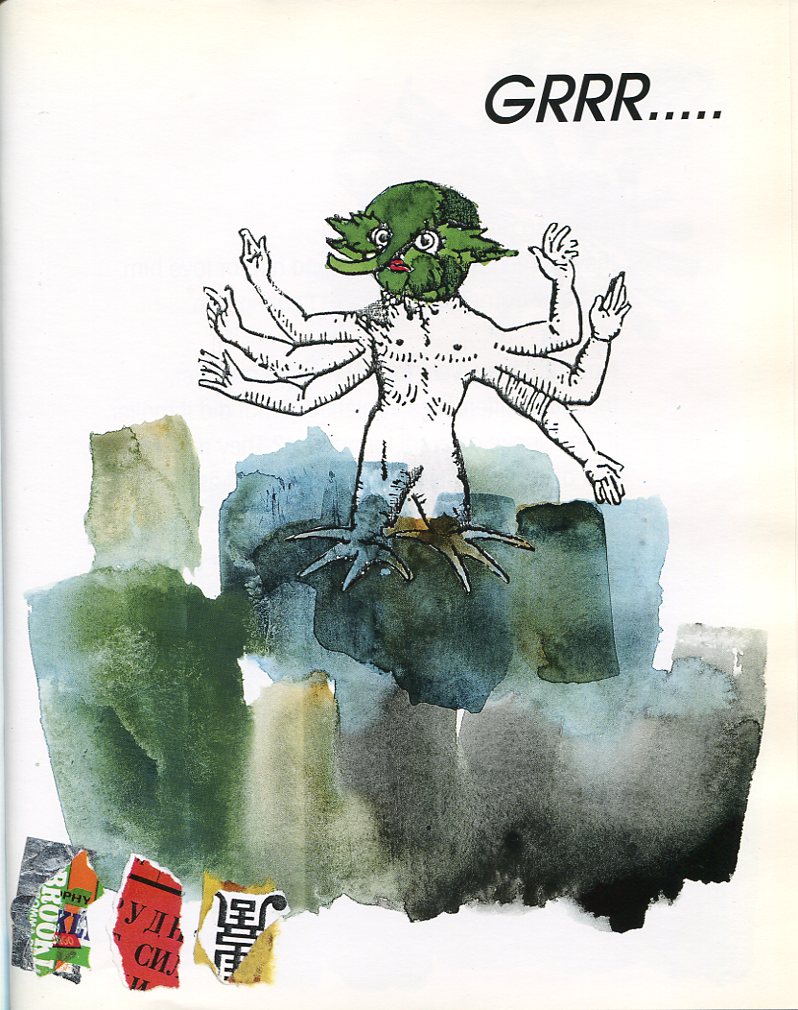
First thing in the morning, a Martian shows up, and he's so scary looking that all three humans band together, and point their "atomic disintegrators" at him, ready to kill him. He, for his part, finds the humans to be "horrible creatures."

Then a baby bird falls from its nest, and the astronauts and the Martian all pause, and shed a tear for such a heartbreaking sight. The Martian picks up the bird and tries to shelter it, and the humans realize he's feeling the same thing they are, and they go over and shake his hands and all of them decide to return to Earth together.

"And so the visitors realized that on Earth, and on other planets, too, each one has his ways, and it's simply a matter of reaching an understanding."

WHILE THE SUBJECT IN THE THREE ASTRONAUTS feels somewhat dated, its message is not, which is why the Family Opera Initiative is currently developing an opera based on the book. A composer from each of the three countries--America, Russia, and China--is composing music, with words by American poet Nikki Giovanni. (They're looking for donations, so do click through.)

In my post on The Bomb and the General, I went into some depth raising the question, what does Eco's text say about Eco's concept of children's literature, without offering any kind of answer. It's not often that you get an answer from the artist himself, but Eugenio Carmi sat for an interview in conjunction with the opera, which provides insight into the way in which the book was created, and how he and Eco thought about children's literature.


Coming soon: Umberto Eco and Eugenio Carmi's The Gnomes of Gnu.

All images are copyrighted © and owned by their respective holders.

Friday, February 10, 2012

JAMES JOYCE: THE CATS OF COPENHAGEN

SEVENTY-SIX YEARS AFTER IT WAS WRITTEN, and forty-eight years after the publication in picture book form of his first children's book (We Too Were Children's first blog post ever), James Joyce has another children's book out: The Cats of Copenhagen.

If you have €300-€1200 that is.

Like his first children's book, The Cat and the Devil, The Cats of Copenhagen was written in a letter to James Joyce's grandson Stephen while Joyce was living in Denmark and his grandson in Paris. Unlike The Cat and the Devil, which originally appeared in Joyce's collected letters, The Cats of Copenhagen has not been previously published in any form. This new edition was made possible, according to the publisher Ithys Press, when James Joyce's works entered the public domain in Europe on January 1, 2012. That position has sparked some controversy, however, as the owner of the letter, the Zurich James Joyce Foundation, claims that it has yet to be determined if unpublished works are also in the public domain.

The Ithys Press edition is to be published in limited edition of 200 copies: 26 lettered, 170 numbered, and 4 Hors Commerce.

Here's hoping a popular edition will be published soon.

All images are copyrighted © and owned by their respective holders.


Wednesday, February 8, 2012

UMBERTO ECO: THE BOMB AND THE GENERAL

WHEN I FIRST STARTED WE TOO WERE CHILDREN, MR. BARRIE, one of the things I hoped to examine was the way in which an author accustomed to writing for adults conceived of writing for children. Why? Because, as many authors included on the blog have noted, childhood reading is often the reading that is most influential on a writer (or on any individual). Consequently, if a writer who is aware of the importance of childhood reading writes what he hopes will be an influential text for the next generation, how does what he includes in that text reveal what he thinks is most important to literature?

This question takes on new meaning when it comes to the works of Umberto Eco, an author who so understands the influence of childhood reading that he wrote an entire novel, The Mysterious Flame of Queen Loana (2005), in which the main character seeks to define his very identity from the books and comic books of his youth. Eco, most famous for his novel In the Name of the Rose (1980), first rose to prominence in academic circles as a Medievalist, philosopher, and semiotician.

Semiotics is the study of signs and their meanings. This includes the way in which words signify actual objects. For example, we call an apple by the word "apple," but a physical apple does not actually contain the word "apple." How then, does the word "apple" relate to the physical object? In what way does the word "apple" cause people to relate to the object? And how does the word "apple" function in a variety of contexts? These questions are of special importance when dealing with children, because children are only just learning about the world, and a lot of that learning is done through language acquisition. So, to a baby, the object apple is simply an observable object. But through language acquisition, it acquires the sign "apple." And as the child ages, the sign "apple" also comes to encompass secondary contextual meanings, say New York City's nickname "The Big Apple," or the symbolic meaning of an apple in the Adam and Eve story. Since so much of this learning comes from books (think of all of the "My first word..." books, which are simply photographs of objects paired with the relevant word), a semiotician writing a children's book, would not only bring concerns of its literary impact, but also of its linguistic, semiotic impact as well.

Which brings us to Umberto Eco. Almost. Eco's major contribution to semiotics is in the application of semiotics to literature. Eco expostulated the theory of "open texts" and "closed texts." An "open text" is one that allows multiple interpretations. A "closed text" dictates one interpretation. It is a question of whether a whole sequence of signs, the words and sentences that make up a story, can have different meanings than the signs usually have. Children's books, picture books in particular, are usually "closed texts." They have a specific message that is dictated to the child, a moral or lesson a child is supposed to take away from the story. Despite the myriad of interpretations his adult novels invite, Eco's picture books are no exception. They preach peace, understanding, and environmentalism.


Are you still with me? It's almost story time. I promise. Let's just go back a paragraph for a moment.

Remember the "My first word..." books? Picture = word, right? Eco's books seem at first to almost take that approach. All the books are done in two page spreads. The page on the left contains nothing but text. The page on the right contains nothing but a picture. But the picture is often abstract (see the "atom" in the spread on the left). These books don't teach words. They are highly representational. But the books' messages are closed, dictated, and even the abstract images contribute to that effect.

How? For that I must direct you to the article by Maria Truglio, Wise Gnomes, Nervous Astronauts, and a Very Bad General: The Children's Books of Umberto Eco and Eugenio Carmi, in Children's Literature, Volume 36, 2008, which is where I got pretty much all of my much watered-down version. Basically, while the illustrations Carmi uses are abstract, they contain their own recurring symbols--follow those little atom circles up above and the general to the right as we go forward. Those symbols then reiterate the story, reinforcing its message.

And of my original question, what do all of these concerns reveal about Eco's idea of literature? I'll let you decide.

ORIGINALLY PUBLISHED IN ITALIAN IN 1966, The Bomb and the General is the first of Eco and Carmi's three picture books. Revised and reissued in 1988, the books received English translations (by William Weaver, the translator of most of Eco's novels), which Truglio notes in her essay, are sometimes interpretations of the original text in a way.

"Once upon a time there was an atom."

"And once upon a time there was a bad general who wore a uniform covered with gold braid."

Atoms are the building blocks of the world. "Mom is made of atoms. Milk is made of atoms." And when all of the atoms are in harmony, then life is good.

But when atoms are broken, "A terrifying explosion takes place! This is atomic death."

Well, the atom had been put in a bomb, and the general had a lot of bombs. "'When I have lots and lots,' he said, 'I'll start a beautiful war!'"

"How can you help but become bad when you have all of those bombs within reach?"

The atom, along with his fellow atoms, don't want to blow up the world and cause death and destruction. So they sneak out of the bombs, which are in the attic, and hang out in the cellar.

Finally, goaded by his financial backers, the general does declare war. He loads the bombs onto airplanes and starts dropping them.

The people begin to run around in a panic. "But where could they find refuge?"

But the bombs sans atoms, don't explode, and everyone is happy, and they realize life is better without war. They decide to never make war again.

"And what about the general?" He becomes a doorman at a hotel "to make use of his uniform with all the braid." Everyone treats him as a lowly menial, even people who once had to obey him, and the general is embarrassed. "Because now he was of no importance at all."

TO SEE MORE OF THE BOMB AND THE GENERAL, check out my Flickr set here. And anyone who wants to correct my discussion on semiotics or to extend it, please do. I am by no means an expert.

Coming soon: Umberto Eco and Eugenio Carmi's Three Astronauts.

All images are copyrighted © and owned by their respective holders.

Friday, December 30, 2011

ELEANOR ROOSEVELT: CHRISTMAS

THE FIRST WORDS that come to mind when you hear the name Eleanor Roosevelt are First Lady. After that perhaps you think, founding member of the United Nations and architect of the Universal Declaration of Human Rights. If you lived through her public life, you then might think: writer. After all, she wrote a daily newspaper column for twenty-six years, a monthly magazine column for Woman's Home Companion, autobiographies, and many other articles and books, making writing one of her primary professions. But children's writer?

Starting in 1932, Eleanor Roosevelt wrote or co-wrote many books for children, most of which were civic-minded nonfiction like When You Grow Up to Vote (1932), This Is America (1942), Partners: The United Nations and Youth (1950), United Nations: What You Should Know About It (1955), and Your Teens and Mine (1961). She also served on the editorial board of the Junior Literature Guild's book club, selecting monthly titles and reviewing manuscripts. And in two instances, she wrote chidren's fiction, albeit didactic fiction: A Trip to Washington With Bobby and Betty (1935) and Christmas (1940).

The former is exactly what it sounds like including a lunch with the President. The latter is an earnest and heartfelt story that first appeared in the December 28, 1940 issue of Liberty magazine. (Liberty was a weekly general interest magazine to which almost anyone of any significance contributed at one time or another. Think Albert Einstein, Joe Dimaggio, Mahatma Gandhi, etc.) Christmas 1940, to put it mildly, was not a happy time. Nazi Germany had either conquered or was about to conquer most of Europe. Japan had done the same in eastern Asia. Roosevelt, as First Lady and a humanitarian, was painfully aware of these events, and felt it was important for all Americans to be informed as well. As she put it in the 1940 Knopf first edition of Christmas:
"The times are so serious that even children should be made to understand that there are vital differences in people's beliefs which lead to differences in behavior.
     This little story, I hope, will appeal enough to children so they will read it and as they grow older, they may understand that the love, and peace and gentleness typified by the Christ Child, leads us to a way of life for which we must all strive." 
IN THE OCCUPIED NETHERLANDS seven-year-old Marta and her mother are preparing for a lonesome Christmas. Marta has her mother recount the previous year's Christmas, when her father came home from his post at the border to celebrate with them. Even then, in 1939, Marta's grandparents could not join them as money needed to be conserved for the expected lean year ahead. But her father came on Christmas Eve, St. Nicholas left her "sweets, a doll, and bright red mittens just like the stockings mother made," the whole family went ice skating, and they had a Christmas feast. Marta innocently tells of how, when she and her mother are together:
"'we always say: "I wonder if Father remembers what we are doing now," and we try to do just the things we do when you are home so you can really know just where we are and can almost see us all the time.'"
At the end of the bittersweet visit, Marta's father puts on his uniform, tells Marta "'Take good care of Moeder until I come back," and leaves, never to return.

In the interim, along with her father's death comes the occupation of her country. "There was no school any more...and on the road she met children who talked a strange language and they made fun of her and said now this country was theirs."

In order to persevere, Marta often speaks to the Christ Child. For "God...was far away in His heaven...[but] Marta could believe...that the Christ Child...was a real child." So on St. Nicholas's Eve, 1940, knowing that "St. Nicholas will not come tonight," Marta says to her mother:
"'There is one candle in the cupboard left from last year's feast. May I light it in the house so the light will shine out for the Christ Child to see His way? Perhaps He will come to us since St. Nicholas forgot us.'"
Her  mother consents, Marta sets the candle in the window, and then goes outside to see just how far away the candle can be seen. Outside, she meets a man.
"She was not exactly afraid of this stranger, for she was a brave little girl, but she felt a sense of chill creeping through her, for there was something awe-inspiring and rather repellent about this personage who simply stood in the gloom watching her."
When she tells him why she has come out, he remonstrates, "You must not believe in any such legend...There is no Christ Child."

Marta listens patiently to his diatribe even though "down inside her something was hurt...[The man] was taking away a hope, a hope that someone could do more than even her mother."

When she at last asks permission to return home, the man comes with her, entering the house without knocking. Marta sees at once that her mother is holding the glowing Christ Child in her arms. The man, just sees an ordinary baby. He chastises the mother for teaching her daughter "a foolish legend."
"The woman answered in a very low voice: 'To those of us who suffer, that is a hope we may cherish. Under your power, there is fear, and you have created a strength before which people tremble. But on Christmas Eve strange things happen and new powers are sometimes born.'"
She goes on in this vein and at last the man turns and leaves. But:
"The light in the window must be the dream which holds us all until we ultimately win back to the things for which [her father] Jon died and for which Marta and her mother were living."
IN THE 1986 EDITION, CHRISTMAS, 1940, Roosevelt's son Elliott Roosevelt writes in the introduction, "'Christmas, 1940' is the kind of story that is rarely written today. I suppose our tastes have changed, as has our style." Despite his hope that the message is still valid, he is right that our tastes have changed, and Christmas now reads as heavy handed and didactic. And while that usually does not bother a young child, the subject matter is now too distant to make this a Christmas tradition.

THE ILLUSTRATIONS used throughout this post come from the first edition and are by the graphic designer and illustrator Fritz Kredel. In addition to the 1986 edition, there was a 1963 edition entitled Eleanor Roosevelt's Christmas Book that also included Roosevelt's reminiscences of Christmas at Hyde Park and the White House. For background information, I consulted the Eleanor Roosevelt Encyclopedia. The photo of the book jacket comes from the Bauman Rare Books website.

All images are copyrighted © and owned by their respective holders.

Tuesday, December 27, 2011

HAPPY HANUKKAH: GUEST POST ON VINTAGE KIDS' BOOKS MY KID LOVES

JUST IN TIME for the final candle, I have a guest post over at the magnificent Vintage Kids' Books My Kid Loves: The Adventures of K'Ton Ton by Sadie Rose Weilerstein. Look out for a new We Too Were Children post before the end of 2011. Until then, hop on over to Vintage Kids' Books to finish up your Hanukkah celebration.

All images are copyrighted © and owned by their respective holders.